
Benjamin Walworth Arnold House and Carriage House
- Architect
- Stanford White
- Year
- 1902
- Style
- Colonial Revival
- City
- Albany, NY
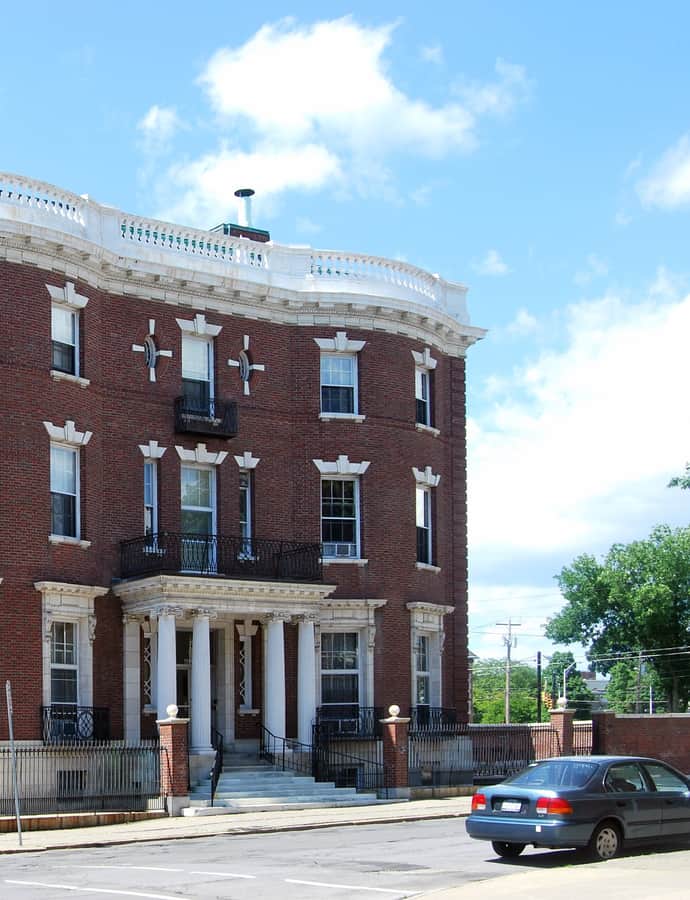

The Benjamin Walworth Arnold House and Carriage House, built in brick at State Street and Washington Avenue in 1902, were designed by Stanford White for a local lumber magnate — the only work White ever built in Albany. When completed they were the first Colonial Revival buildings in the city and its first fully electrified house, and they drew considerable attention for it. The house now serves as offices for the New York State Catholic Conference, with the carriage house home to an architectural firm.
the building
House and carriage house ensemble. The estate pairs a main house with a separate carriage house on a one-acre lot at the northwest corner of State and Sprague, opposite Washington Park — together they form a notable turn-of-the-century domestic ensemble rare for downtown Albany.
First fully electrified house. Beyond its architectural novelty as Albany's first Colonial Revival building, the house was wired from the start as the city's first fully electrified residence, a marker of how far ahead of its neighbors the commission was pushing.
the style
The house and carriage house were Albany's first Colonial Revival buildings, a style that stood apart from the Victorian and Gothic Revival fashions dominant in the city at the time and helped introduce a new architectural vocabulary to Albany's elite residential streets.
More on Colonial Revivalthe architect
Stanford White, of the firm McKim, Mead & White, was one of the most sought-after architects of his era; the Arnold House and Carriage House represent his only built work in Albany.
significance
The buildings were listed as a contributing property to the Washington Park Historic District when it joined the National Register of Historic Places in 1972, and were listed individually on the Register in 1982.
nearby
- Albany Institute of History & Art
- Alfred E. Smith Building
- Cathedral of All Saints
- New York State Education Building
- New York State Capitol
- The Egg