
Texas State Capitol
- Architect
- Elijah E. Myers
- Year
- 1885
- Style
- Renaissance Revival
- City
- Austin, TX
- Collection
- capitol classical
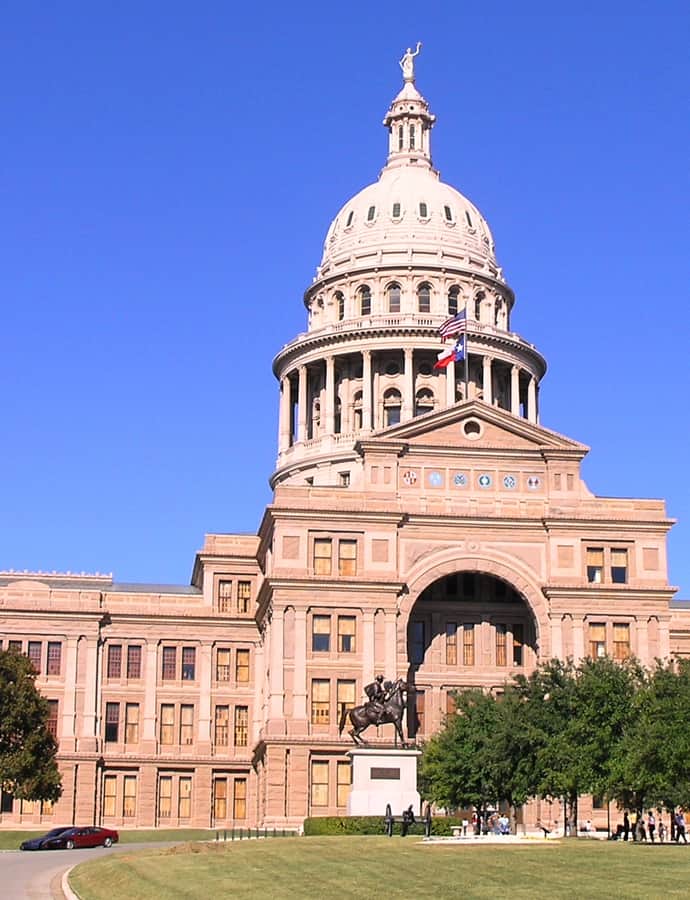

The Texas State Capitol is the fourth building to serve as the seat of Texas government in Austin, replacing an original two-room wooden structure. Designed in 1881 by Elijah E. Myers, it was built between 1882 and 1888 under civil engineer Reuben Lindsay Walker and houses the Texas Legislature and the Governor's offices. At 302.64 feet tall, it ranks as the sixth-tallest state capitol in the country and stands taller than the U.S. Capitol in Washington, D.C. — a comparison Texans have made since it opened.
the building
Taller than Washington's. At 302.64 feet, the Capitol rises higher than the U.S. Capitol in Washington, D.C., making it the sixth-tallest state capitol building in the country — a comparison Texans have pointed to since it opened in 1888.
The underground extension. A $75 million extension was built beneath the Capitol grounds and completed in 1993, adding modern legislative space without altering the historic building visible from the street.
Fourth capitol on this site. This is the fourth building to serve as the Texas capitol in Austin; the first was a plain two-room wooden structure that served as the seat of the Republic of Texas before the state's admission to the Union.
the style
The Capitol's design mixes Renaissance Revival and Mediterranean Revival elements, the high-classical vocabulary favored for major American government buildings of the late 19th century, chosen by Elijah E. Myers to project permanence and authority for the Legislature and Governor's offices it houses.
More on Renaissance Revivalthe architect
Elijah E. Myers was a nationally significant capitol architect who designed the building in 1881; construction ran from 1882 to 1888 under the direction of civil engineer Reuben Lindsay Walker.
significance
The Capitol was added to the National Register of Historic Places in 1970 and designated a National Historic Landmark in 1986. It was ranked 92nd in the American Institute of Architects' 2007 'America's Favorite Architecture' poll, and at 302.64 feet remains taller than the U.S. Capitol in Washington, D.C.
nearby
- Westgate Tower
- Wahrenberger House
- General Land Office Building
- Austin Daily Tribune Building
- Texas Governor's Mansion
- Central Christian Church