
Ames Building
- Architect
- Shepley, Rutan and Coolidge
- Year
- 1889
- Style
- Richardsonian Romanesque
- City
- Boston, MA
- Collection
- richardson romanesque
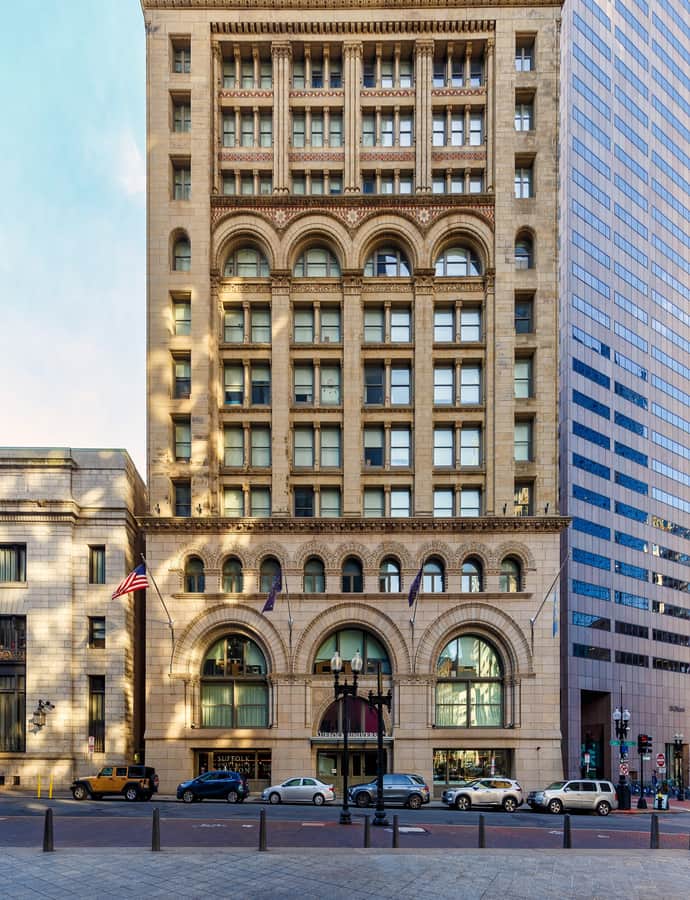

The Ames Building at 1 Court Street was completed in 1889 for Frederick L. Ames and is considered Boston's first skyscraper, sometimes ranked as the city's tallest building until the Custom House Tower opened in 1915. Designed by Shepley, Rutan and Coolidge in Richardsonian Romanesque, it was converted from offices to a luxury hotel in 2007 and purchased by Suffolk University in 2020 for use as a student residence hall.
the building
Masonry pushed to its limit. At fourteen stories, the Ames Building is the second-tallest masonry load-bearing-wall structure in the world, exceeded only by Chicago's Monadnock Building, completed the same year - a scale that made it one of the last major buildings to rely on solid masonry walls rather than a steel frame to carry its own weight.
Granite base, sandstone skin. The building is faced in granite and sandstone, with a four-story base of large arches framing the second- and third-floor windows on Romanesque columns, and smaller arches marking the upper stories. The sandstone came from the Berea formation in Ohio, supplied by Cleveland Quarries.
the style
The Ames Building is built in the Richardsonian Romanesque style, named for Henry Hobson Richardson, and its arched masonry base and load-bearing walls show that style's response to the emerging problem of the tall commercial building, just as steel-frame construction was beginning to make it obsolete for skyscrapers.
More on Richardsonian Romanesquethe architect
Shepley, Rutan and Coolidge was the successor firm to Henry Hobson Richardson's practice, formed by three of his associates after his death. The Ames Building shows the firm carrying Richardson's Romanesque vocabulary into a taller commercial building than he himself had built.
significance
The Ames Building is an approved Boston Landmark (#71, designated November 23, 1993) and is listed on the National Register of Historic Places. It has been repurposed twice in recent decades, from offices into a luxury hotel in 2007 and then into a Suffolk University student residence hall in 2020.
nearby
- Old State House
- Second Brazer Building
- Boston City Hall
- Old City Hall
- Suffolk Savings Bank
- Old Corner Bookstore