
Edmund Fowle House
- Architect
- Sturgis and Brigham
- Year
- 1772
- Style
- Georgian
- City
- Boston, MA
- Collection
- colonial & revolutionary
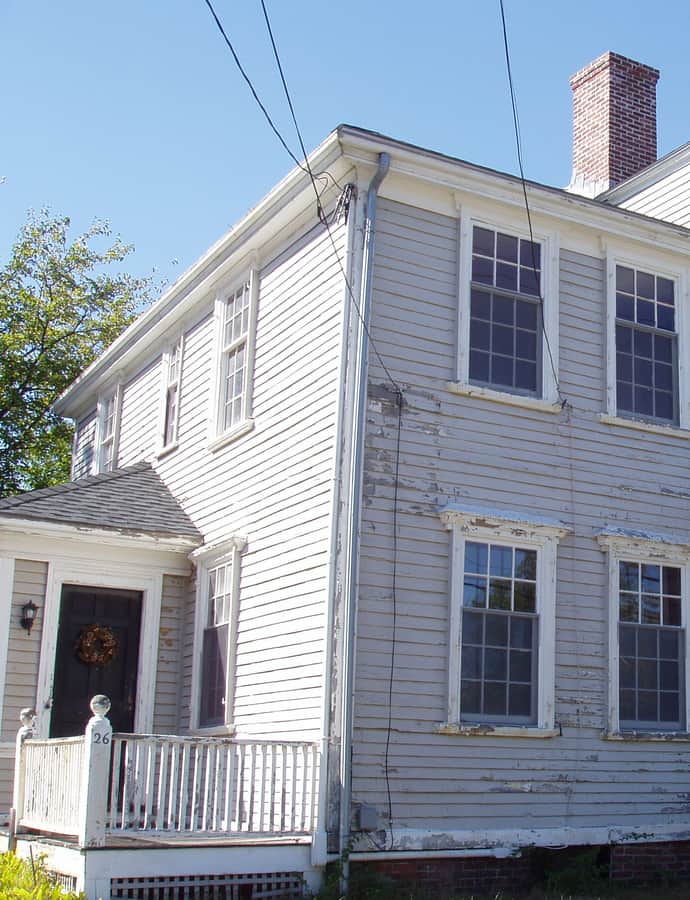

Built in 1772, the Edmund Fowle House is the second-oldest surviving house in Watertown, Massachusetts, predated only by the c. 1698 Browne House. During the first year of the Revolutionary War it served as the meeting place for the Massachusetts Executive Council, the de facto seat of Massachusetts government while the British occupied Boston. Now a local history museum, it stands on Marshall Street near Watertown Square, a physical link to the state's wartime government-in-exile.
the building
The entrance vestibule. The five-bay clapboarded facade centers on a projecting, flat-roofed enclosed vestibule sheltering the front door. The entry is flanked by sidelight windows and framed in fluted moulding, the most refined touch on an otherwise plain wood-frame house.
the style
The house is a Georgian-era survival: two stories, a hip roof, a central chimney, and a symmetrical five-bay front, the standard formula for a well-off New England household of the 1770s.
More on Georgiansignificance
The house is owned by the local historical society and operates as a museum; it was listed on the National Register of Historic Places in 1977.
nearby
- Saint John Methodist Episcopal Church
- First Baptist Church
- Watertown Savings Bank
- Watertown Administration Building
- Old Watertown High School
- House at 60 William Street