
Farmers' and Exchange Bank
- Year
- 1853
- Style
- Moorish / Mudéjar
- City
- Charleston, SC
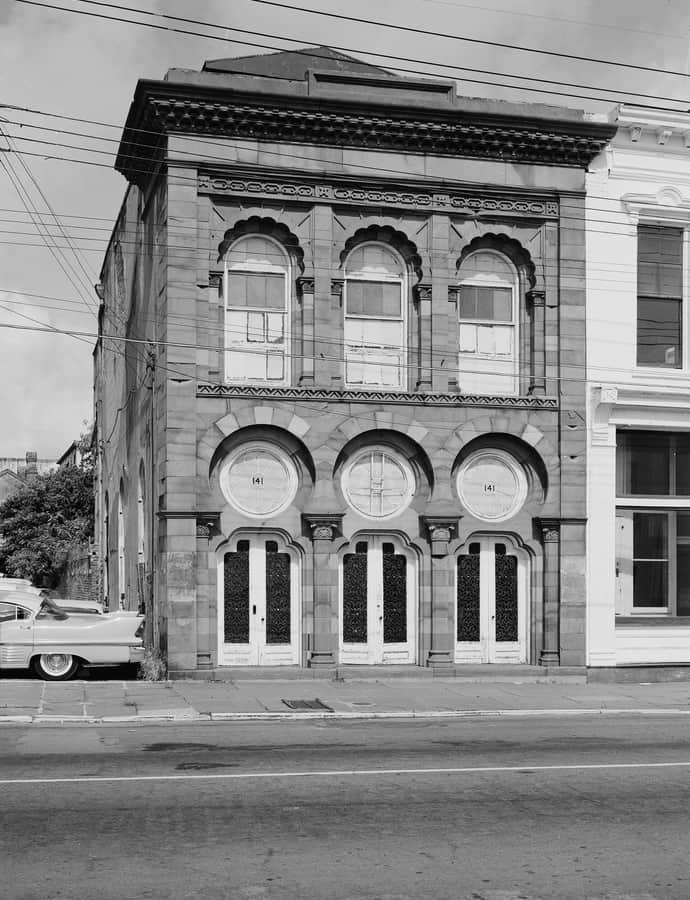

Built in 1853-54 on the west side of East Bay Street, the Farmers' and Exchange Bank is one of the rare American examples of Moorish Revival architecture, designed by Charleston architects Edward C. Jones and Francis D. Lee. Its striking red sandstone facade and use of muqarnas, an ornamental form characteristic of Persian and North African architecture, made it distinctive enough to earn National Historic Landmark status in 1973.
the building
Muqarnas facade. The three-bay facade is built of brick and multiple shades of brownstone finished in stucco, each bay filled by a tall Moorish arched opening using muqarnas ornament rarely seen on American commercial buildings of the period.
Carved entry doors. The first-floor openings take a contoured Moorish shape, with circular windows set above entries fitted with intricately carved doors. The second-floor openings echo the form, their upper circular sections finished with a scalloped edge and filled with large multi-pane fixed windows.
the style
The bank is a rare American use of Moorish Revival, a style seldom applied to United States commercial architecture, distinguished here by its muqarnas ornament, contoured arched openings, and red sandstone coloring.
More on Moorish / Mudéjarthe architect
Edward C. Jones and Francis D. Lee, both Charleston architects, designed the bank together.
significance
Declared a National Historic Landmark in 1973 for its architecturally distinctive Moorish Revival design, rarely seen in the United States.
nearby
- Exchange and Provost Building
- St. Philip's Episcopal Church
- Dock Street Theatre
- Heyward-Washington House
- Powder Magazine
- U. S. Custom House