
Hunter Museum of American Art
- Architect
- Abram Garfield
- Year
- 1952
- Style
- Georgian
- City
- Chattanooga, TN
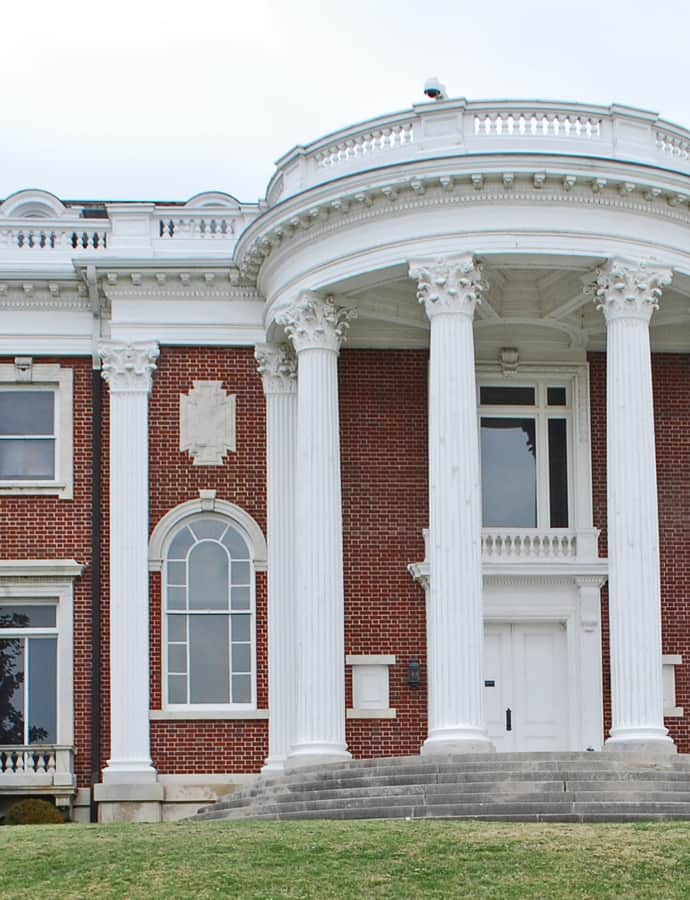

The Hunter Museum of American Art occupies an 80-foot bluff over the Tennessee River downtown, and its building tells its history in layers: the 1904 classical revival Faxon House, designed by Abram Garfield (son of President James A. Garfield), became the museum's home when it opened in 1952, later joined by a 1975 brutalist addition and a 2005 entrance addition by Randall Stout. The museum's collections span the Hudson River School, American Impressionism, the Ashcan School, and postwar modern and contemporary art.
the building
The Faxon House. The original 1904 mansion at the museum's core was built on a bluff site once occupied by a Confederate battery, in what was then a prestigious address for Victorian houses in what is now the Bluff View Art District.
Three eras of building. The museum is a composite of three distinct architectural stages: Garfield's 1904 classical revival mansion, a 1975 brutalist addition, and a 2005 entrance wing designed by Randall Stout.
Riverfront connection. The Ruth S. and A. William Holmberg Pedestrian Bridge links the museum site to the nearby Walnut Street Bridge and the downtown riverfront.
the style
The museum's original building was designed in the classical revival style in 1904, later joined by a brutalist addition in 1975 and a contemporary 2005 addition by Randall Stout, giving the complex a mix of Georgian Revival-era formality and later modern interventions.
More on Georgianthe architect
Abram Garfield, son of President James A. Garfield, designed the original 1904 mansion that now anchors the museum; the later 2005 addition was designed by Randall Stout.
significance
The building is individually listed on the National Register of Historic Places and has housed the Hunter Museum of American Art since 1952.
nearby
- Wiley United Methodist Church
- Frances Willard House
- Soldiers and Sailors Memorial Auditorium
- Tivoli Theatre
- First Presbyterian Church
- Chattanooga Bank Building