
Inland Steel Building
- Architect
- Skidmore, Owings & Merrill
- Year
- 1957
- Style
- International Style
- City
- Chicago, IL
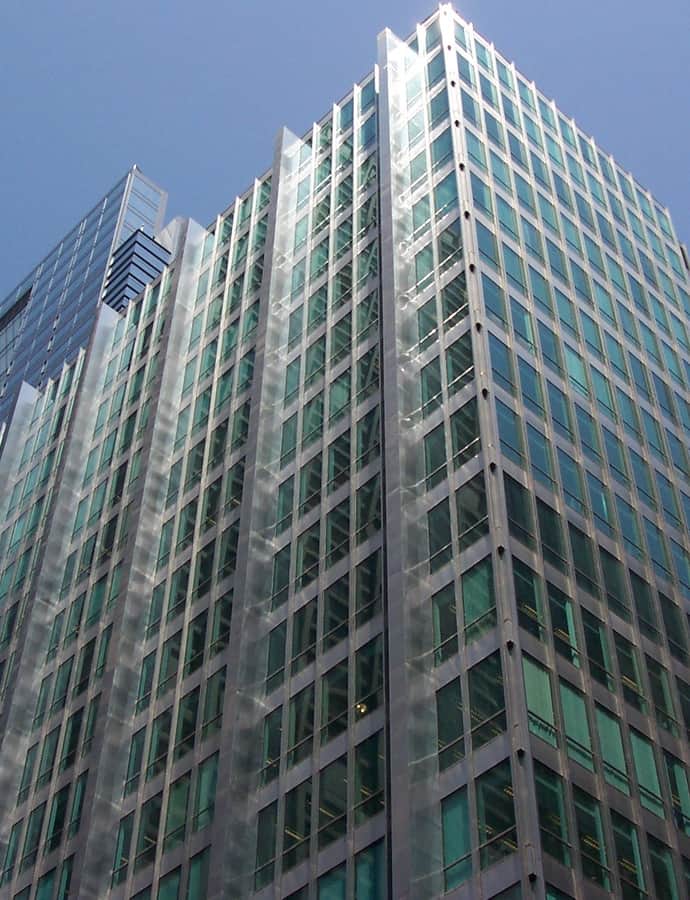

The Inland Steel Building, completed in 1958 at 30 West Monroe Street, was built as headquarters for the Inland Steel Company after it outgrew its previous home, the First National Bank Building. Designed by Bruce Graham and Walter Netsch of Skidmore, Owings & Merrill, it was one of the first new skyscrapers to rise in the Loop since World War II, reaching 332 feet. Its steel-framed International Style front announced that Chicago's postwar office towers would again be defined by structural ambition.
the building
Column-free floors. Inland Steel was designed with its structural columns pushed entirely to the building's exterior, giving every office floor a column-free interior, an engineering move that let the steel company's own tenants work in open, uninterrupted space.
The 1954 lease. Inland Steel announced in August 1954 that it would lease a site at Monroe and Dearborn from the Chicago Board of Education; SOM's plans followed in March 1955, construction began January 1956, and the building was nearly fully leased before it opened on February 3, 1958.
the style
Graham and Netsch designed Inland Steel in the International Style, expressing its steel frame directly on the exterior rather than hiding it behind ornament, a fitting face for a steel manufacturer's own headquarters and part of a wave of postwar towers that reintroduced structural steel and glass to the Loop skyline after a long wartime pause in construction.
More on International Stylethe architect
Bruce Graham and Walter Netsch designed Inland Steel while both worked at Skidmore, Owings & Merrill; each went on to shape Chicago's skyline further, with Graham later leading the design of the Sears Tower and John Hancock Center, part of SOM's dominance of large-scale Chicago commercial architecture in the postwar decades.
significance
Inland Steel is a Chicago Landmark and is listed on the National Register of Historic Places, with the city designation recorded October 7, 1998. Inland Steel Company owned the building until the late 1980s, eventually occupying two-thirds of it, before it passed briefly to a Japanese ownership group and then to JPS Interests.
nearby
- Chicago Building
- Sullivan Center
- Marquette Building
- Carson Pirie Scott & Company Building
- Chicago Federal Building
- Palmer House Hotel