
Savoyard Centre
- Architect
- McKim, Mead & White
- Style
- Neoclassical
- City
- Detroit, MI
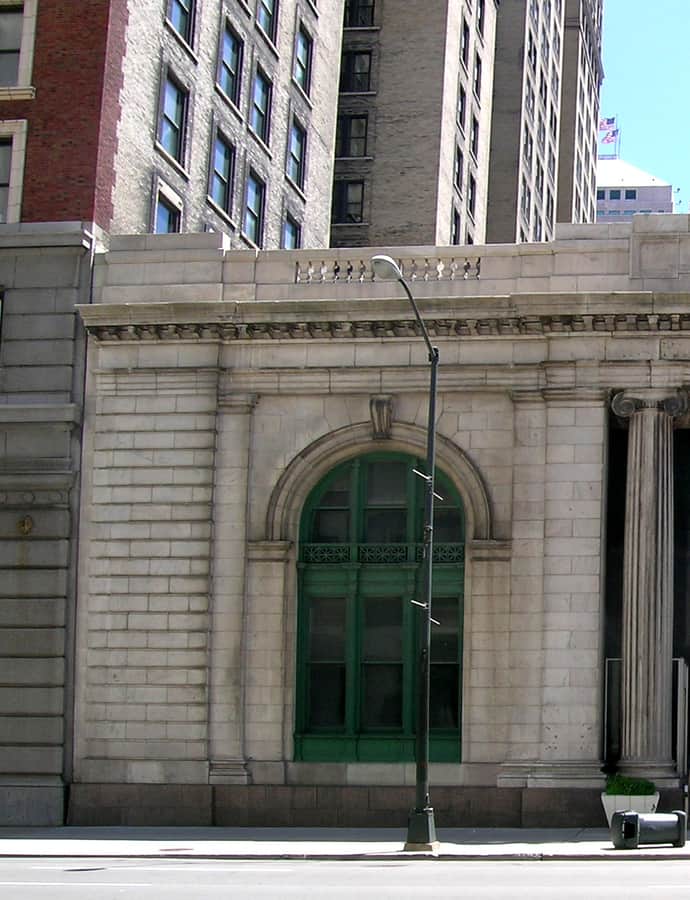

The Savoyard Centre, built in 1900 as the State Savings Bank at 151 West Fort Street, was commissioned by an institution that had grown into Detroit's largest bank. State Savings Bank organized in 1883 and bought this corner of Fort and Shelby in 1898, then hired the prominent architect Stanford White of McKim, Mead & White to design a Neo-Classical bank sheathed in white marble inside and out. The site itself carried older history: a marker here notes it was previously occupied by Fort Lernoult until British troops evacuated on July 11, 1796, in compliance with the Treaty of Paris ending the Revolutionary War.
the building
The Ionic entrance. The main entrance sits in a recessed portico framed by two Ionic columns 28 feet tall and weighing 56,000 pounds each, an outsized classical gesture meant to signal the bank's wealth and stability to anyone walking up Fort Street.
The cartouche above the door. Above the entry, a cartouche bears the Michigan Coat of Arms flanked by two carved figures representing Industry and Commerce, tying the bank's identity directly to the state it served.
White marble throughout. Both the interior and exterior walls are finished in white marble, a material choice that carried the bank's Neo-Classical formality from the street straight into the banking hall.
the style
White designed the building in the Neo-Classical style favored for major American banks of the era, using a temple-front portico and monumental Ionic columns to project the permanence and trustworthiness depositors expected of the largest bank in Detroit.
More on Neoclassicalthe architect
Stanford White, of the New York firm McKim, Mead & White, was one of the most sought-after architects in the country when State Savings Bank commissioned him for this building; McKim, Mead & White were among the era's most significant American architecture firms, shaping the classical civic and commercial architecture of the period.
significance
The building was designated a Michigan State Historic Site in 1981 and listed on the National Register of Historic Places in 1982. A separate historic marker, erected November 13, 1964, commemorates the site's earlier role as Fort Lernoult, evacuated by British troops in 1796 under the Treaty of Paris.
nearby
- Penobscot Building
- Buhl Building
- Theodore Levin United States Courthouse
- Federal Reserve Bank of Chicago Detroit Branch Building
- Ford Building
- Chrysler House