
Duke Chapel
- Architect
- Julian Abele
- Year
- 1932
- Style
- Gothic Revival
- City
- Durham, NC
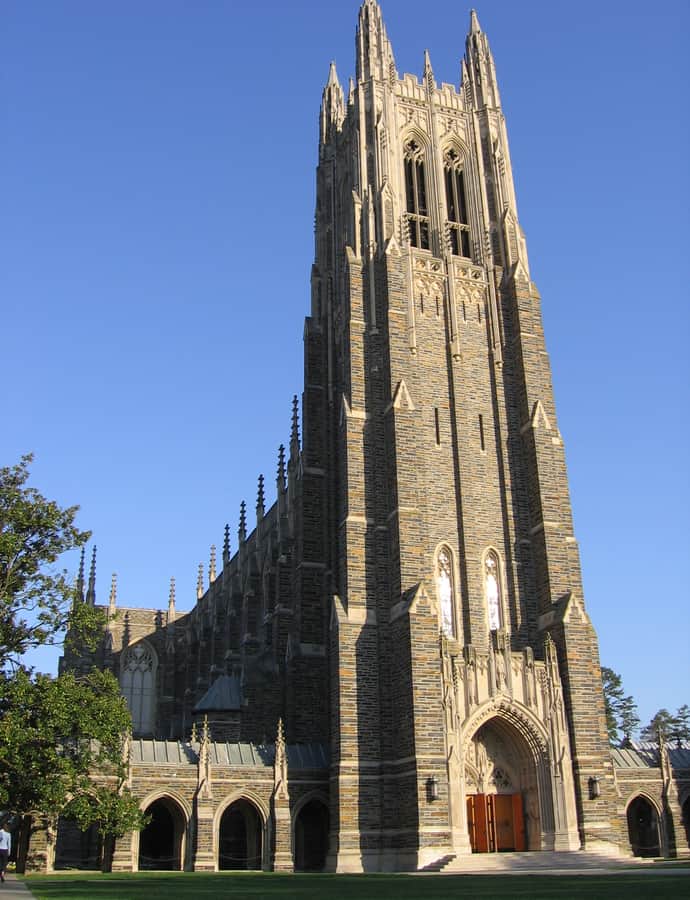

Duke Chapel stands at the center of Duke University's West Campus, on the highest ridge of the site. Designed by Julian Abele, a historically significant African American architect, it was first used during Commencement in 1932 while still under construction, though it wasn't formally finished and dedicated until June 2, 1935, at a cost of $2.3 million. Built in the Collegiate Gothic style, it seats about 1,800 people and stands 210 feet tall, making it one of the tallest buildings in Durham County.
the building
Scale and stone. The chapel is built of large stones with pointed arches and ribbed vaults, hallmarks of the Collegiate Gothic style. At 210 feet, it was one of the tallest buildings in Durham County, and it was the last of the original buildings completed on West Campus.
Bells and pipes. The chapel houses a 50-bell carillon and three pipe organs, one with 5,033 pipes and another with 6,900 pipes — instruments built at a scale to match the building's soaring interior.
A slow construction. Plans for a chapel were first made in April 1925, but the cornerstone wasn't laid until October 22, 1930. It was used for Commencement in 1932 mid-construction, and not formally dedicated until June 2, 1935.
the style
The chapel is built in the Collegiate Gothic style, marked by large stones, pointed arches, and ribbed vaults — a campus-wide vocabulary chosen to give Duke's West Campus the weight and verticality of an older institution, culminating in the chapel at its highest point.
More on Gothic Revivalthe architect
Julian Abele designed the chapel; he is recognized as a historically significant African American architect, working at a time when his profession offered few Black architects such prominent commissions.
significance
At 210 feet tall, Duke Chapel was one of the tallest buildings in Durham County, and it serves as the ecumenical center of religious life at Duke, with connections to the United Methodist Church.
nearby
- Nasher Museum of Art
- Duke Memorial United Methodist Church
- John Sprunt Hill House
- Hill Building
- Durham Hosiery Mills Dye House