
Aliiolani Hale
- Architect
- Thomas Rowe
- Style
- Renaissance Revival
- City
- Honolulu, HI
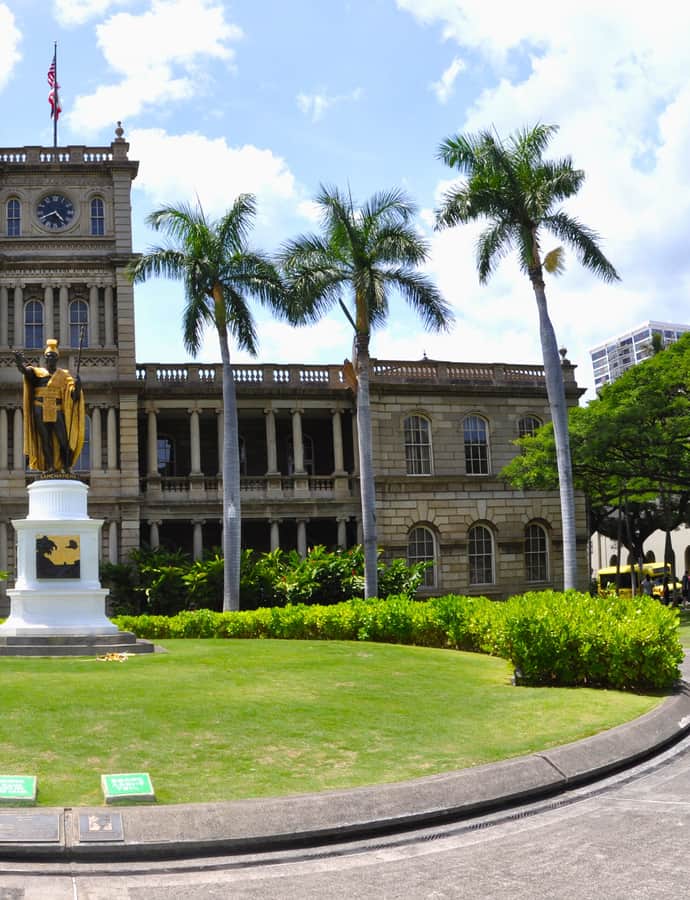

Aliʻiōlani Hale was designed by Australian architect Thomas Rowe in an Italian Renaissance Revival style, commissioned by King Kamehameha V as a royal palace before he redirected it into a much-needed government office building. Kamehameha V laid the cornerstone on February 19, 1872, and died before it was completed; the building was dedicated in 1874. Its name means "House of Heavenly Kings" in Hawaiian. It served as the seat of government for both the Kingdom of Hawaiʻi and the Republic of Hawaiʻi, and today houses the Hawaiʻi State Supreme Court.
the building
From palace to statehouse. Kamehameha V originally ordered Aliʻiōlani Hale as a royal palace, but recognized that the Hawaiian government's existing buildings were too small and cramped for its growing needs, so he had it built as a government office building instead.
The Kamehameha statue. In the building's courtyard stands the famed gold-leaf statue of Kamehameha the Great, a landmark feature of the site.
the style
Thomas Rowe designed Aliʻiōlani Hale in an Italian Renaissance Revival style as a royal commission for King Kamehameha V, whose given name Aliʻiōlani lent the building its title.
More on Renaissance Revivalthe architect
Thomas Rowe was an Australian architect who designed Aliʻiōlani Hale for King Kamehameha V.
significance
Aliʻiōlani Hale is listed on the National Register of Historic Places both individually and as a contributing property, and carries an OSM heritage=2 designation.
nearby
- King David Kalakaua Building
- ʻIolani Palace
- Royal Brewery
- Hawaii State Capitol
- Washington Place
- Cathedral Church of Saint Andrew, Honolulu