
Episcopal Church of the Nativity
- Architect
- Frank Wills
- Year
- 1859
- Style
- Gothic Revival
- City
- Huntsville, AL
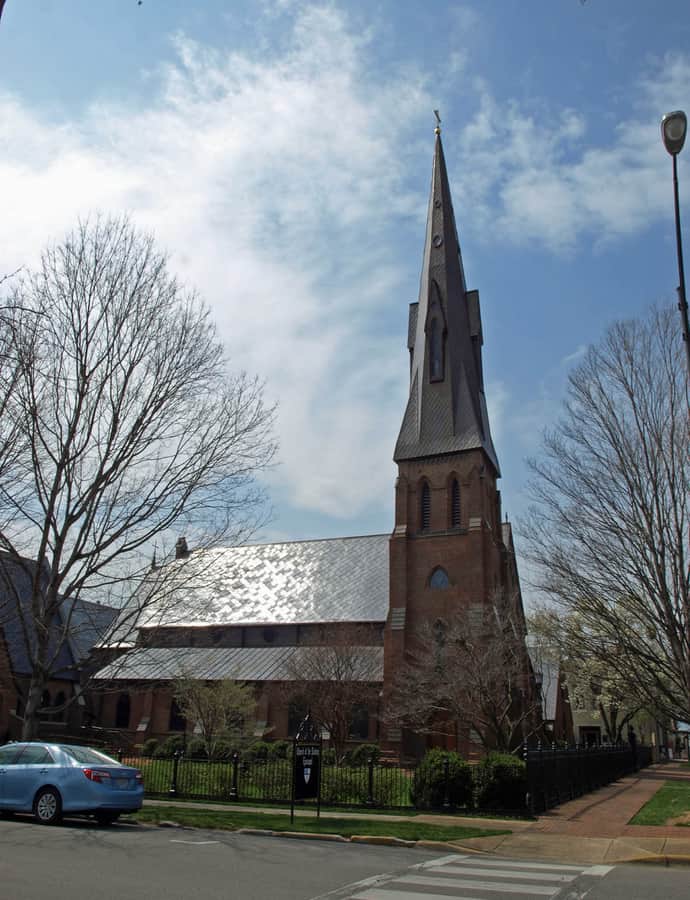

The Episcopal Church of the Nativity was completed in 1859 to designs by Frank Wills, replacing an 1847 sanctuary that had already grown too small for its congregation. Minister Henry C. Lay chose Wills after seeing his Trinity Episcopal Church going up in Mobile in 1856, and the vestry bought two lots at Eustis Avenue and Green Street for $3,923 to build on. It is regarded as one of the most pristine examples of Ecclesiological Gothic architecture in the South, and one of only thirteen surviving houses of worship Wills designed in the United States.
the building
A minister's road trip. The design owes itself to a chance encounter: in January 1856, Henry C. Lay was in Mobile and saw Frank Wills and Henry Dudley's Trinity Episcopal Church under construction. He hired the same firm on the spot for Huntsville's new sanctuary, replacing the original 1847 building the congregation had outgrown.
Built by subscription. A building committee spent three years raising the construction funds by subscription while work proceeded, on land the vestry had purchased at the corner of Eustis Avenue and Green Street for $3,923. A local builder, Hugh N. Moore, carried out the construction.
the style
Nativity is built in the Gothic Revival style and is considered one of the most pristine examples of Ecclesiological Gothic architecture in the South. It is also one of the least-altered of Frank Wills's works, and one of only thirteen surviving houses of worship he designed in the United States.
More on Gothic Revivalthe architect
Frank Wills designed Nativity together with his firm partner Henry Dudley, whose Trinity Episcopal Church in Mobile so impressed the Huntsville minister that he hired the same architects. Only thirteen of Wills's houses of worship survive in the United States, and Nativity is counted among the least altered.
significance
The church was declared a National Historic Landmark in 1990 and is also listed on the National Register of Historic Places.