
Accident Fund Building
- Architect
- Bowd–Munson Company
- Year
- 1939
- Style
- Art Deco
- City
- Lansing, MI
- Collection
- company’s lansing
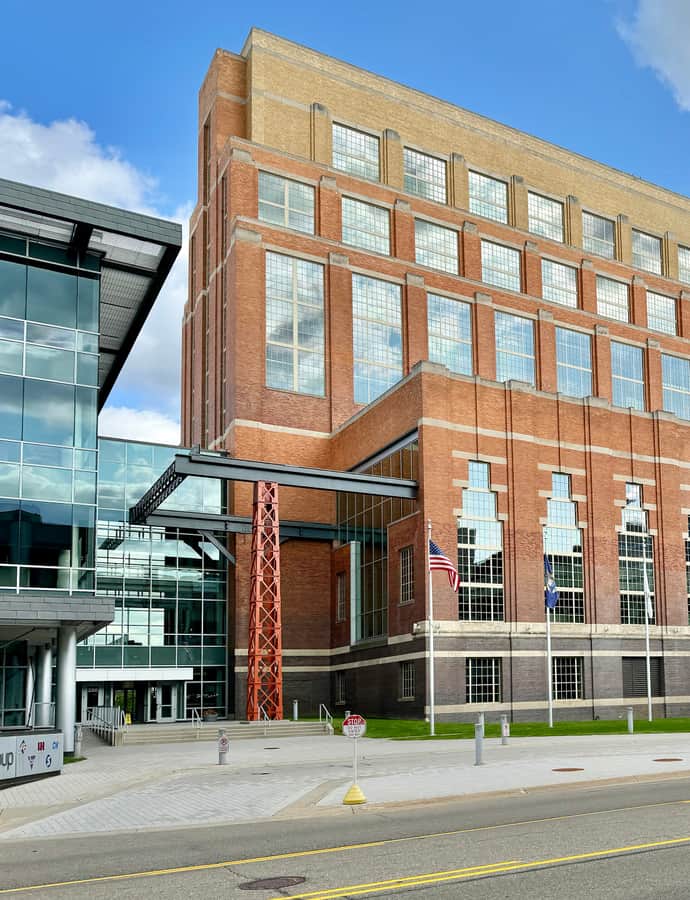

Originally the Ottawa Street Power Station, this Art Deco plant was built for the Lansing Board of Water and Light in the late 1930s, with engineering by Burns and Roe and architectural design by the Bowd–Munson Company. It generated electricity and steam for the city until 1992, briefly served as a chilled water plant in the early 2000s, and was remodeled into offices for the Accident Fund Insurance Company of America in the early 2010s. It's listed on the National Register of Historic Places.
the building
Engineering by Burns and Roe. The plant's engineering, by Ralph C. Roe and Allen Burns, improved on the design of the Bremo Station in Virginia, which the two engineers had earlier designed while at the Electric Management and Engineering Company.
Wartime construction in two phases. Construction began in 1937 but was completed in two phases because of material shortages caused by the outbreak of World War II; the first phase, the southern half of the building, was completed first.
the style
Edwyn A. Bowd of Bowd and Munson gave the power station an Art Deco architectural treatment, dressing an industrial power plant in the era's fashionable geometric ornament rather than purely utilitarian design.
More on Art Decothe architect
Edwyn A. Bowd, of the Lansing firm Bowd–Munson Company, designed the architectural elements while engineers Ralph C. Roe and Allen Burns of Burns and Roe handled the plant's technical systems.
significance
Listed on the National Register of Historic Places, the building's downtown location and design made it a strong candidate for adaptive reuse after its power-generating life ended in 1992, leading to its remodel into offices for the Accident Fund Insurance Company in the early 2010s.
nearby
- Michigan Millers Mutual Fire Insurance Company Building
- Christman Building
- First Baptist Church
- Central Methodist Episcopal Church
- Boji Tower
- Strand Theatre and Arcade