
Hollywood Studio Club
- Architect
- Julia Morgan
- Style
- Renaissance Revival
- City
- Los Angeles, CA
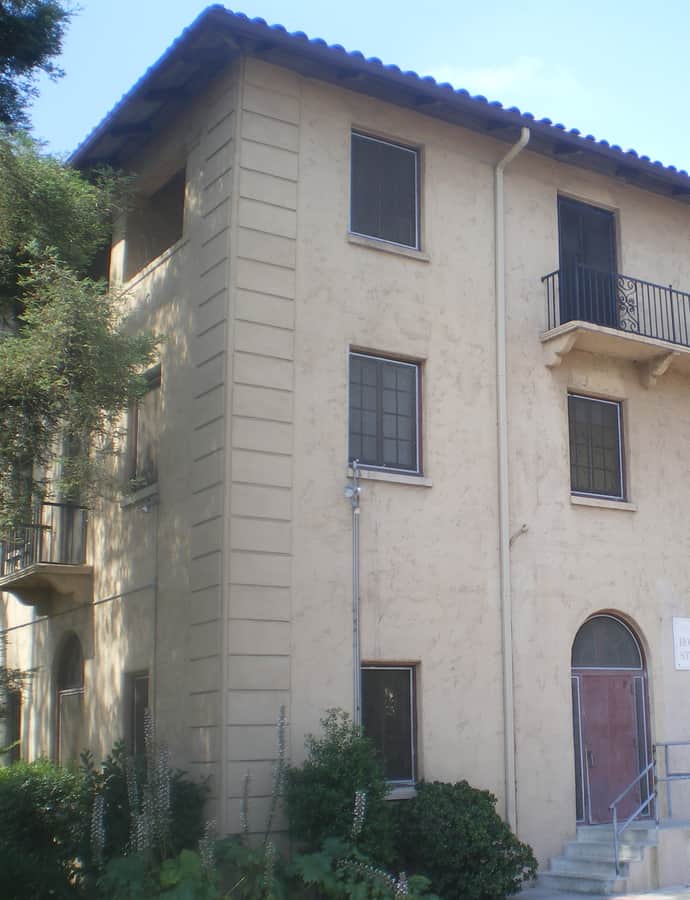

The Hollywood Studio Club began in 1916 as informal gatherings of aspiring actresses reading plays in the basement of the Hollywood Public Library, and grew into a chaperoned YWCA dormitory that housed roughly 10,000 women in the film business over 59 years. Architect Julia Morgan, who also designed Hearst Castle, gave the building its Italian Renaissance Revival design. Residents over the decades included Marilyn Monroe, Ayn Rand, Donna Reed, Kim Novak, and Sharon Tate, before the Studio Club closed in 1975.
the building
A roster of famous residents. The dormitory housed Marilyn Monroe, Ayn Rand, Donna Reed, Kim Novak, Maureen O'Sullivan, Rita Moreno, Barbara Eden, and Sharon Tate among roughly 10,000 women who passed through over 59 years.
Life after the Studio Club. The Studio Club closed in 1975, but the YWCA kept using the building as a Job Corps dormitory until April 30, 2012; it remains YWCA Greater Los Angeles property today.
the style
The Studio Club is built in the Italian Renaissance Revival style, a formal, classically inspired treatment for what was, in effect, a supervised boarding house for young women new to Hollywood.
More on Renaissance Revivalthe architect
Julia Morgan was a pioneering California architect best known for designing Hearst Castle for William Randolph Hearst; the Studio Club is one of her institutional commissions in Los Angeles.
significance
The Hollywood Studio Club was listed on the National Register of Historic Places in 1979. It remains owned by the YWCA of Greater Los Angeles, decades after housing thousands of women trying to break into the movie business.
nearby
- Earl Carroll Theatre
- Guaranty Building
- Los Angeles Fire Department Museum and Memorial
- Old Warner Brothers Studios
- Hollywood Plaza Hotel
- Leed's Building