
Freedom Tower
- Year
- 1925
- Style
- Spanish Colonial Revival
- City
- Miami, FL
- Collection
- mediterranean fantasy
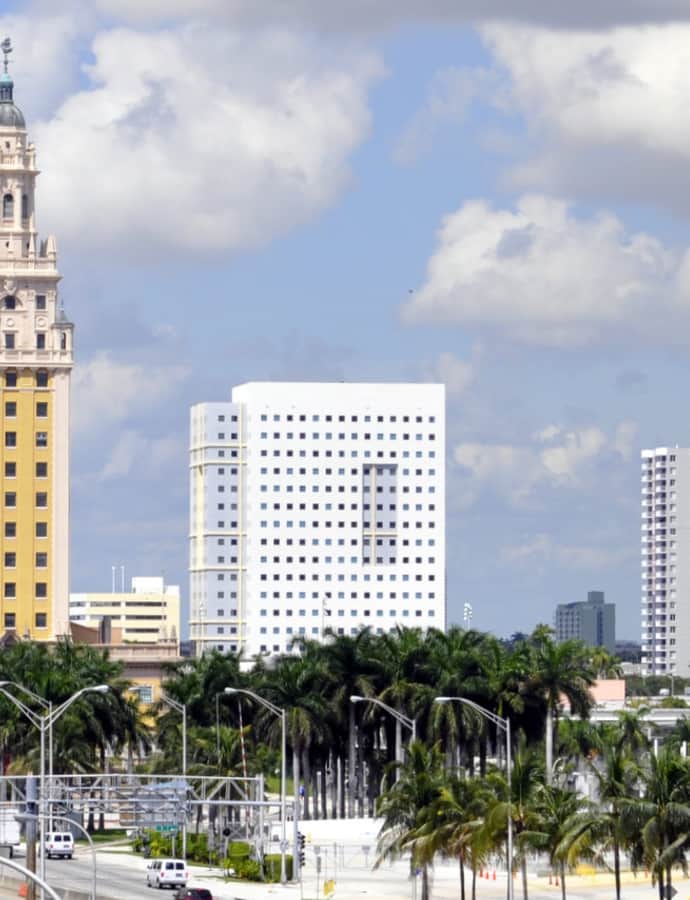

Freedom Tower rose in 1925 at 600 Biscayne Boulevard as the headquarters and printing plant of the newspaper the Miami News, designed by Schultze and Weaver in the Mediterranean Revival style. In the 1960s the building became a processing center for Cuban refugees fleeing the 1959 revolution, work that later earned it the name Freedom Tower and, in Spanish, Torre de la Libertad. It now serves as a contemporary art museum and arts office for Miami Dade College, whose Wolfson Campus surrounds it.
the building
A newspaper's headquarters. The tower was built in 1925 as the headquarters and printing facility of the newspaper the Miami News, which is why the AIA's Florida Chapter later listed it as the 'Freedom Tower/Formerly Miami News and Metropolis Building.'
Cuban refugee processing. Through the 1960s the building processed Cuban refugees arriving after the 1959 revolution, registering and assisting new arrivals — the role that gave the tower its name and led to its 2008 National Historic Landmark designation.
Now an art museum. Freedom Tower today functions as a contemporary art museum and central arts office for Miami Dade College, part of the school's Wolfson Campus at the building's original Biscayne Boulevard address.
the style
Freedom Tower's Mediterranean Revival design gave a working newspaper plant the ornamental dress of a Spanish-inspired tower, a common move for prominent 1920s Miami buildings trying to project romance and permanence during the era's land boom.
More on Spanish Colonial Revivalthe architect
Freedom Tower was designed by Schultze and Weaver, the same New York firm that completed the Biltmore Hotel in Coral Gables the following year, giving the pair of 1925-26 landmarks a shared architectural hand.
significance
Freedom Tower was added to the National Register of Historic Places in 1979 and designated a National Historic Landmark in 2008 for its role sheltering and processing Cuban refugees after the 1959 revolution. The AIA's Florida Chapter later placed it on its list of Florida Architecture: 100 Years, 100 Places.
nearby
- David W. Dyer Federal Building and United States Courthouse
- One Thousand Museum
- Meyer-Kiser Building
- Shoreland Arcade
- Security Building
- Central Baptist Church