
Oakleigh Historic Complex
- Style
- Greek Revival
- City
- Mobile, AL
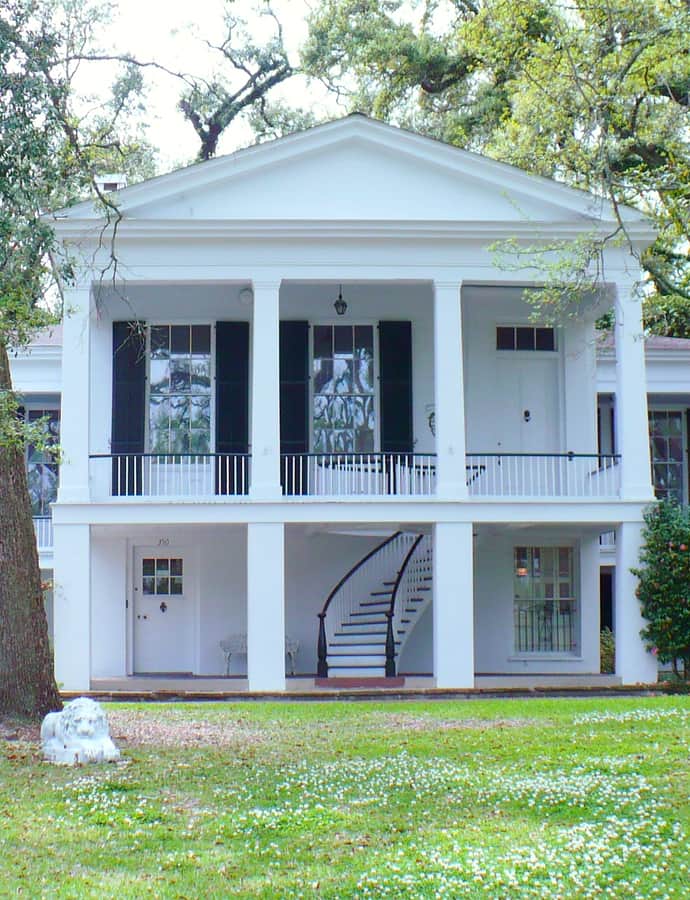

Oakleigh is a c. 1833 Greek Revival house museum built by James W. Roper, a brick mason and dry goods merchant and cotton factor from James City County, Virginia, on 33 acres of woodland west of Mobile. Roper chose the site for its valuable clay pit and operated a Water Street brickyard downtown, on the present-day site of the RSA Battle House Tower. The house is now the centerpiece of the Oakleigh Historic Complex, which also includes a working-class raised cottage, Union Barracks, and a modern archives building, within the Oakleigh Garden Historic District named for the estate.
the building
Built through hardship. While building Oakleigh, Roper lost his first wife, Sarah Ann Davenport, and a child; he remarried in 1838 upon the house's completion and had four children with his second wife, Eliza Ann Simison. The Panic of 1837 hit Roper and his business interests hard after he had borrowed $20,000 to build the home.
The estate's name. Oakleigh's name combines the word 'oak' with the Anglo-Saxon word 'lea,' meaning meadow — a name later extended to the surrounding Oakleigh Garden Historic District and neighborhood.
the style
Oakleigh is built in the Greek Revival style, raised on its site with a prominent full-height colonnaded portico that remains an iconic image of antebellum Mobile.
More on Greek Revivalsignificance
Oakleigh is individually listed on the National Register of Historic Places and serves as Mobile's official antebellum house museum, anchoring the Oakleigh Historic Complex alongside a working-class raised cottage, Union Barracks, and a modern archives building.
nearby
- Raphael Semmes House
- Caldwell School
- Barton Academy
- Saint Vincent de Paul
- Cathedral Basilica of the Immaculate Conception
- National African American Archives and Museum