
Tennessee State Capitol
- Architect
- William Strickland
- Year
- 1859
- Style
- Greek Revival
- City
- Nashville, TN
- Collection
- athens of the south
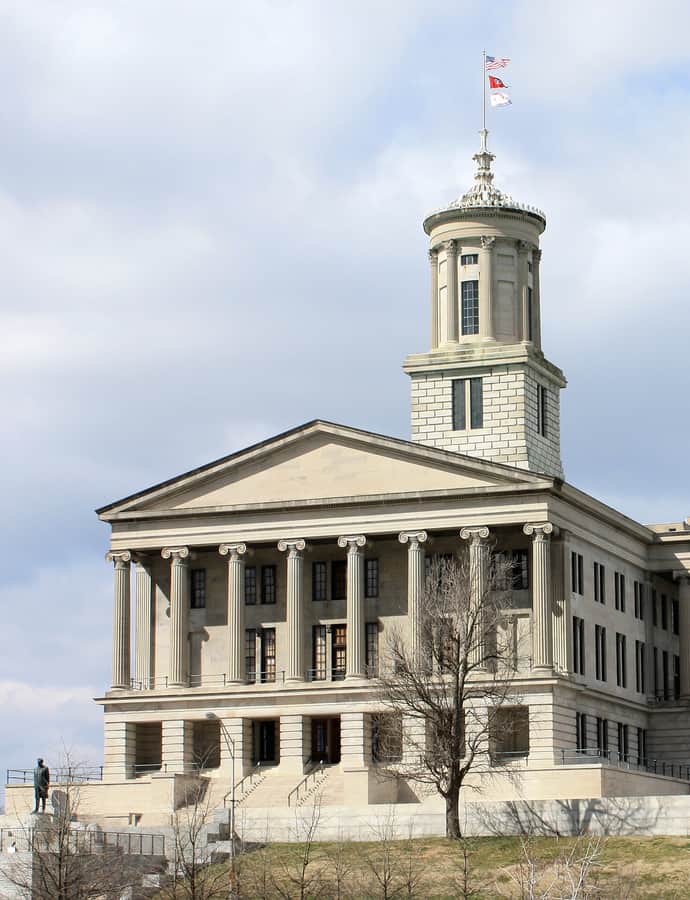

The Tennessee State Capitol was built between 1845 and 1859 to house the Tennessee General Assembly and the governor's office, raised by skilled artisans working alongside convict and slave labor. Architect William Strickland of Philadelphia considered it his greatest achievement, and it became one of Nashville's defining Greek Revival landmarks and one of the oldest state capitols in continuous use, serving as the seat of government since 1853.
the building
No dome. The Capitol is one of just 11 state capitols in the United States built without a dome, a deliberate departure that set it apart among America's statehouses when it opened in 1859.
Iron in the structure. It was one of the first buildings in the United States to use iron as a structural element, built at a moment when American builders were just beginning to trust metal to carry real structural loads alongside stone.
Limestone from a Nashville quarry. The building was constructed predominantly of limestone quarried nearby, giving the Capitol its pale, monumental mass on the highest hill in downtown Nashville.
the style
Strickland worked in the Greek Revival idiom, the standard architectural language for American government buildings of the era, evoking the temples of Athenian democracy to lend gravity to a young state's institutions. Completed in 1859, the Capitol was the tallest building in the Southeastern United States at the time, and remains one of Nashville's most prominent examples of the style.
More on Greek Revivalthe architect
William Strickland was a Philadelphia-trained architect who considered the Tennessee State Capitol his greatest achievement, the capstone of a career that culminated in this 14-year project, built from 1845 to 1859.
significance
The Capitol was listed on the National Register of Historic Places in 1970 and named a National Historic Landmark in 1971. It has also been designated a Historic Civil Engineering Landmark, and it remains one of the oldest working statehouses in the country, having been used continuously since 1853.
nearby
- Tennessee Supreme Court Building
- John Sevier State Office Building
- War Memorial Auditorium
- William R. Snodgrass Tennessee Tower
- St. Mary's Catholic Church
- Hermitage Hotel