
Gallier Hall
- Architect
- James Gallier
- Style
- Greek Revival
- City
- New Orleans, LA
- Collection
- greek revival crescent city
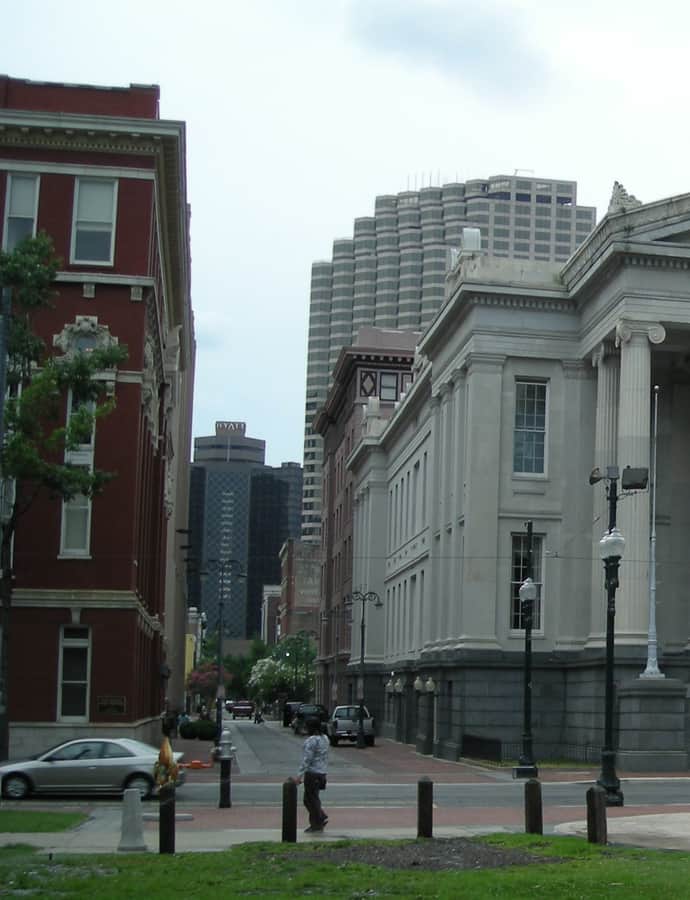

Gallier Hall was built as New Orleans's city hall between 1845 and 1853, and it remains one of the finest works of architect James Gallier Sr. Standing on St. Charles Avenue at Lafayette Square, the marble building served as the seat of city government for just over a century, hosting events through the Civil War, Reconstruction, and the era of Governor Huey Long before the city moved its offices to Duncan Plaza in the 1950s. It was designated a National Historic Landmark in 1974.
the building
The Ionic facade. The building presents a three-story marble front carried by two rows of fluted Ionic columns, a Greek Revival treatment considered one of the most important structures raised in New Orleans during the antebellum period.
A century as city hall. Dedicated in 1853, Gallier Hall functioned as New Orleans's city hall for just over one hundred years, witnessing major events of the Civil War, Reconstruction, and Huey Long's governorship before city offices relocated to the modern Duncan Plaza complex in the 1950s.
Lafayette Square setting. Gallier Hall stands on St. Charles Avenue at Lafayette Square in the Central Business District, placing its classical civic facade squarely across from the square it was built to face.
the style
Gallier worked in the Greek Revival vocabulary, rendering the city hall as a three-story marble front with fluted Ionic columns in the Neoclassical mode — a nationally significant example of the style and one of the most important antebellum buildings raised in the city.
More on Greek Revivalthe architect
James Gallier Sr. was a historically important New Orleans architect, and Gallier Hall is considered one of his finest works, the building most closely tied to his reputation in the city.
significance
Gallier Hall was designated a National Historic Landmark in 1974 and is listed on the National Register of Historic Places. Though city government left for Duncan Plaza in the 1950s, the building continues in civic use today.
nearby
- St. Patrick's Church
- Confederate Memorial Hall
- Howard Library
- Hancock Whitney Center
- Plaza Tower
- Latter & Blum Building