
Carnegie Hall
- Architect
- William Tuthill
- Year
- 1891
- Style
- Renaissance Revival
- City
- Manhattan, NY
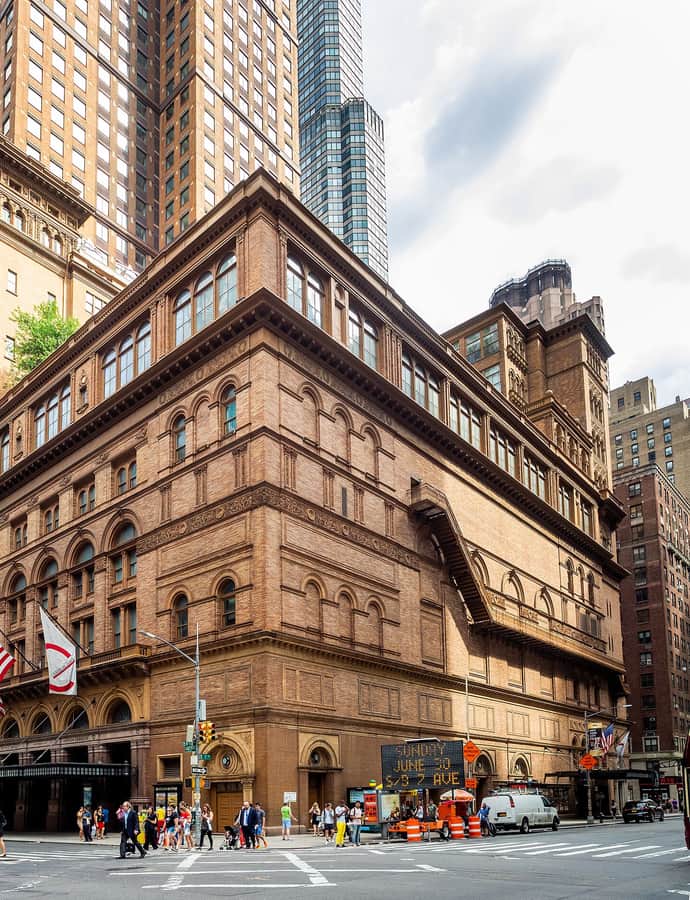

Carnegie Hall, at 881 Seventh Avenue between 56th and 57th Streets, was designed by architect William Burnet Tuthill and built by industrialist and philanthropist Andrew Carnegie between 1889 and 1891. Originally called the Music Hall, it was constructed as a shared venue for the Oratorio Society of New York and the New York Symphony Society and remains one of the most prestigious concert venues in the world for both classical and popular music. It presents about 250 performances a season and, since the New York Philharmonic's move to Lincoln Center in 1962, has had no resident company.
the building
Three auditoriums. The complex holds the 2,790-seat Stern Auditorium, a five-story hall; the 599-seat Zankel Hall, located below ground on Seventh Avenue; and the 268-seat Joan and Sanford I. Weill Recital Hall on 57th Street. Offices occupy the building's top stories above the halls.
the style
Built in a Renaissance Revival and Mediterranean Revival idiom, the hall's exterior reflects the era's taste for dressing large public buildings in historical European forms.
More on Renaissance Revivalthe architect
William Tuthill designed Carnegie Hall as his best-known work, delivering one of the era's defining concert venues for his patron Andrew Carnegie.
significance
Carnegie Hall is a National Historic Landmark, a New York City Individual Landmark (LP-00278) designated June 20, 1967, and is listed on both the National Register of Historic Places and the New York State Register of Historic Places.
nearby
- One57
- 165 West 57th Street
- Osborne Apartments
- 224 West 57th Street
- American Fine Arts Society
- 5 Columbus Circle