
The Octagon
- Architect
- Alexander Jackson Davis
- City
- Manhattan, NY
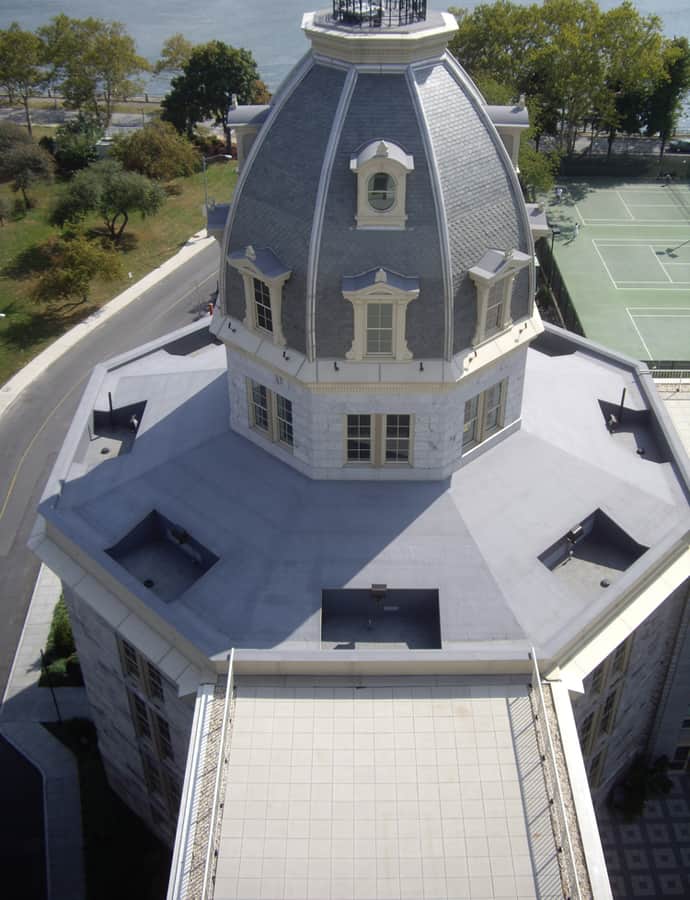

The Octagon is a five-story rotunda built in 1834 and designed by Alexander Jackson Davis, originally serving as the main entrance to the New York City Lunatic Asylum, which opened in 1841 on Roosevelt Island. Built of blue-gray stone quarried on the island, it became notorious after journalist Nellie Bly went undercover as a patient and exposed the mistreatment inside in her 1887 book Ten Days in a Mad-House. The hospital closed in 1955 and the building sat abandoned for decades before restoration incorporated it into a modern apartment complex at 888 Main Street.
the building
Quarried on site. The rotunda's blue-gray stone was quarried right on Roosevelt Island, tying the building physically to the ground it stands on rather than to imported materials.
Last remnant of the asylum. After the hospital closed in 1955 and the surrounding buildings were demolished or lost to fire, the Octagon was the only structure to survive, standing decades in ruin before restoration folded it into a new apartment complex.
the architect
Alexander Jackson Davis designed the Octagon as part of the New York City Mental Health Hospital complex, which opened in 1841.
significance
The Octagon is listed on the National Register of Historic Places, is a New York City Landmark, and is on the New York State Register of Historic Places. It was added to the National Register on March 16, 1972, despite its ruined condition at the time, and its notoriety was cemented by Nellie Bly's 1887 exposé of patient mistreatment at the asylum it once served.
nearby
- 20 East End Avenue
- Blackwell Island Light
- Gracie Mansion
- Chapel of the Good Shepherd
- Bohemian National Hall
- Parsonage of the Church of the Holy Trinity