
Eastern State Penitentiary
- Architect
- John Haviland
- Year
- 1829
- Style
- Gothic Revival
- City
- Philadelphia, PA
- Collection
- victorian philadelphia
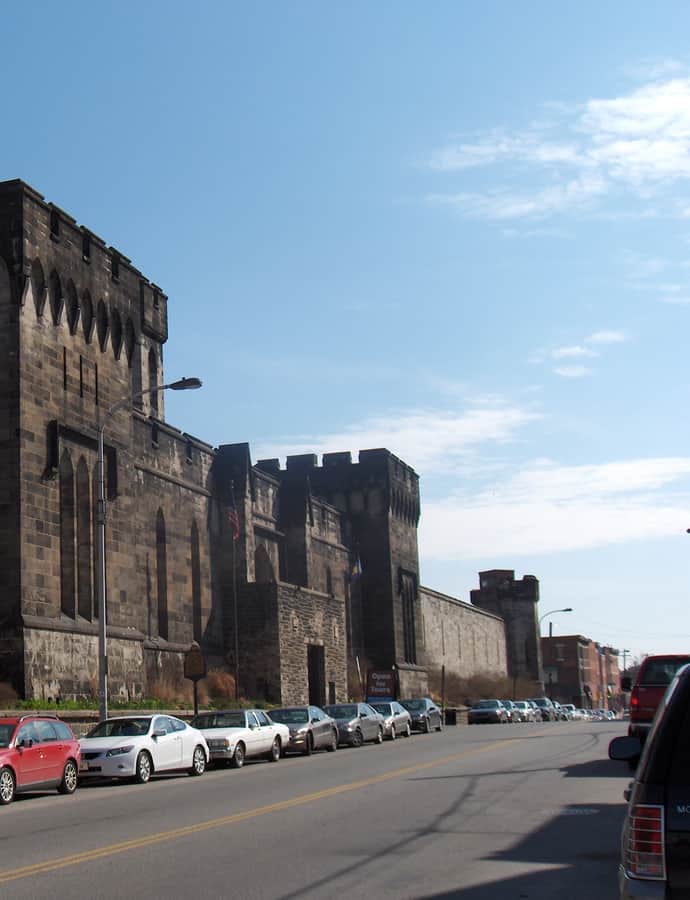

Eastern State Penitentiary opened in 1829 in the Fairmount section of Philadelphia, designed by John Haviland to refine a system of separate incarceration first tried at the city's Walnut Street Jail. At its completion it was the largest and most expensive public structure ever built in the United States, and its radiating wagon-wheel plan became the model for more than 300 prisons built around the world. It operated until 1971 and held inmates including Al Capone and bank robber Willie Sutton before reopening as a museum.
the building
Wagon-wheel plan. Haviland arranged the cell blocks in a radiating wagon-wheel design, an innovative layout intended to let a central point oversee the entire prison while keeping inmates in separate, isolated confinement — the era's new theory of reform through solitude.
the style
Haviland cast the penitentiary in the Gothic Revival style, giving a fortress-like, castle-form exterior to a building whose interior was organized instead around the era's new penal theory of separate incarceration.
More on Gothic Revivalthe architect
John Haviland designed Eastern State Penitentiary, with construction beginning in 1822 on ten acres of elevated farmland then known as Cherry Hill. The wagon-wheel plan he devised, refining the separate-incarceration system pioneered at Philadelphia's Walnut Street Jail, made the prison a model copied in more than 300 prisons worldwide.
significance
Eastern State Penitentiary is a U.S. National Historic Landmark, now open to the public as a museum. Notorious inmates held here included Al Capone and Willie Sutton, and James Bruno and several male relatives, convicted in the 1934 Kelayres massacre, served time here between 1936 and 1948 before being paroled.
nearby
- Fairmount Water Works
- Philadelphia Museum of Art
- Barnes Foundation
- The Met Philadelphia
- Divine Lorraine Hotel
- Congregation Rodeph Shalom