
Racquet Club of Philadelphia
- Architect
- Horace Trumbauer
- Style
- Colonial Revival
- City
- Philadelphia, PA
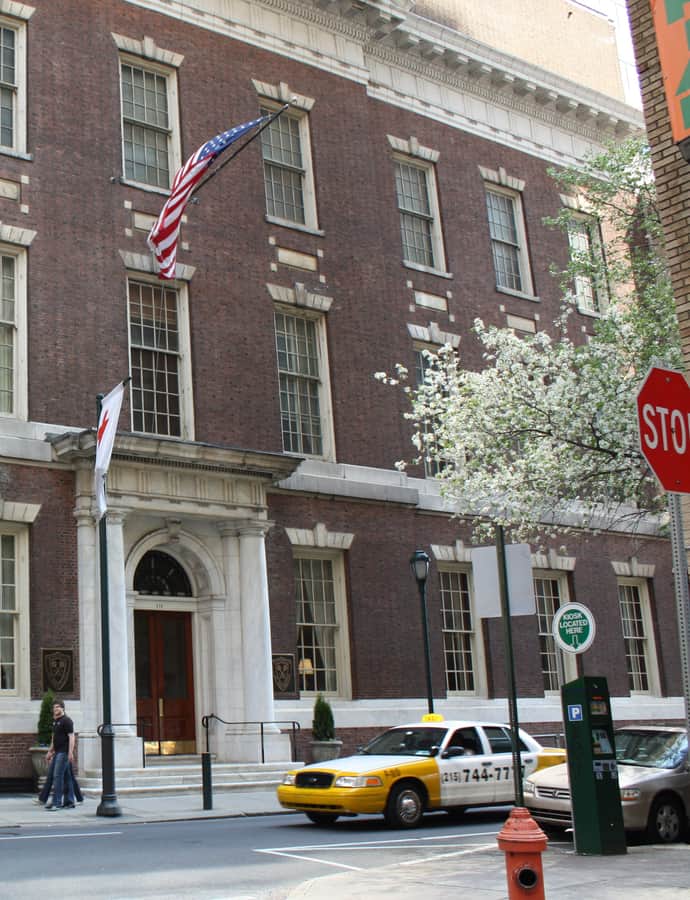

The Racquet Club of Philadelphia has fielded squash, real tennis, and racquets players since 1889, when it started in a rented facility at 923 Walnut Street. Under club leader George D. Widener, it moved into the current 16th Street clubhouse in 1907, a building architect Horace Trumbauer designed in the Colonial Revival style. Historian Nathaniel Burt judged it 'by far the best appointed...of all Philadelphia clubs,' and it remains one of the city's leading athletic clubs today.
the building
Reinforced concrete frame. The 1907 clubhouse is one of the first reinforced concrete structures built in Philadelphia, an unusual engineering choice for a Gilded Age social club more often built with traditional masonry construction.
The swimming pool. Trumbauer's clubhouse holds the world's first above-grade swimming pool, engineered by the Roebling Construction Company, the same firm renowned for building suspension bridges.
the style
Trumbauer designed the clubhouse in the Colonial Revival style, a fitting choice for a club whose members prized old-Philadelphia social tradition. The style's restrained brick facade gives little hint of the building's structural novelty inside.
More on Colonial Revivalthe architect
Horace Trumbauer was among Philadelphia's most sought-after Gilded Age architects, designing grand clubs and residences for the city's elite; the Racquet Club clubhouse counts among his notable commissions.
significance
The clubhouse is listed on the National Register of Historic Places, and the club maintains a separate Historic Preservation & Education Fund, a public charity established in 2015 to support the building's upkeep.
nearby
- St. Mark's Episcopal Church
- Sun Oil Building
- Estey Hall
- Academy of Music
- Drake Hotel
- The Bellevue-Stratford Hotel