
Carnegie Free Library of Allegheny
- Architect
- Smithmeyer & Pelz
- Style
- Romanesque Revival
- City
- Pittsburgh, PA
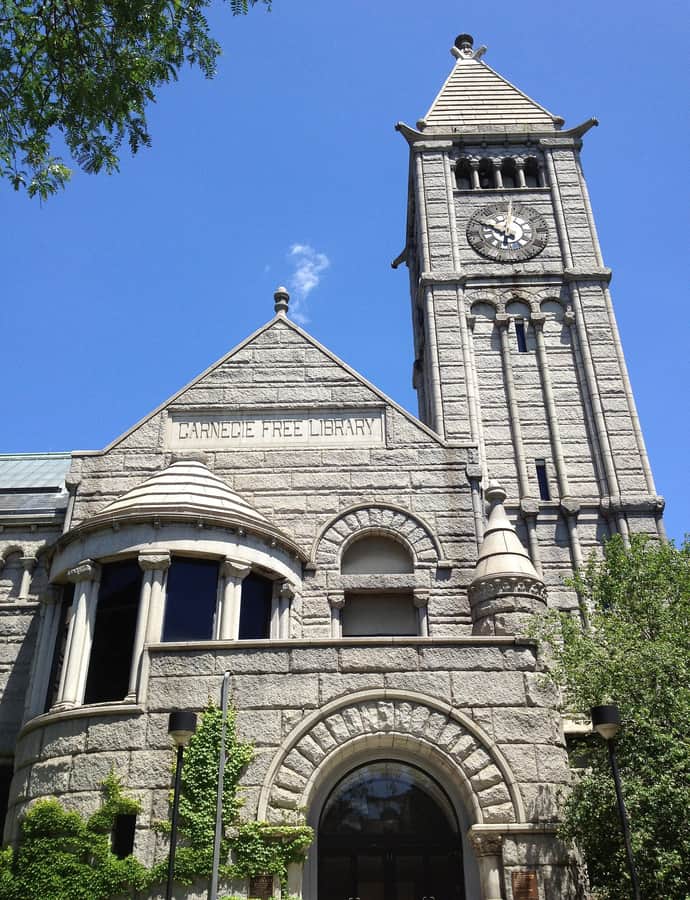

The Carnegie Free Library of Allegheny, in Pittsburgh's Allegheny Center neighborhood, was commissioned in 1886 as the first Carnegie library commissioned in the United States, a gift from steel magnate Andrew Carnegie. Designed by John L. Smithmeyer and Paul J. Pelz - the architects of the Library of Congress - it was built between 1886 and 1890 and opened as the second Carnegie library in the country, after the Carnegie Free Library of Braddock opened in 1889.
the building
Granite shipped from Maine. The library and conservatory were built of red and grey granite shipped from Maine, cut by Vinalhaven's Bodwell Granite Company, the same contractor that supplied stone for the State, War and Navy Department Building in Washington, D.C. (today the Eisenhower Executive Office Building).
The first Carnegie Music Hall. The building houses the first Carnegie Music Hall built in the United States. The Braddock library's own music hall, though its parent library opened a year earlier, would not open until an 1893 expansion.
Funded by taxes, not an endowment. Unlike the Braddock library, which Carnegie endowed, the Allegheny library's running costs were met from local taxes - a different funding model for essentially the same philanthropic gift.
the style
Built in Romanesque Revival style, the library uses its rough Maine granite to convey civic solidity and permanence, fitting for what was conceived as the first library of Carnegie's national library-building program.
More on Romanesque Revivalthe architect
John L. Smithmeyer and Paul J. Pelz, the firm behind the Library of Congress building in Washington, D.C., designed the Allegheny library, bringing the same institutional gravity to Carnegie's first library commission.
significance
The library is listed on the National Register of Historic Places, designated a Pittsburgh History & Landmarks Foundation Historic Landmark, and holds a City of Pittsburgh historic designation, recognition tied to its status as the first library Andrew Carnegie ever commissioned.
nearby
- House at 200 West North Avenue
- Frederick J. Osterling Office and Studio
- B. F. Jones House
- Henderson-Metz House
- Teutonia Maennerchor Hall
- Byers-Lyons House