
Oregon State Capitol
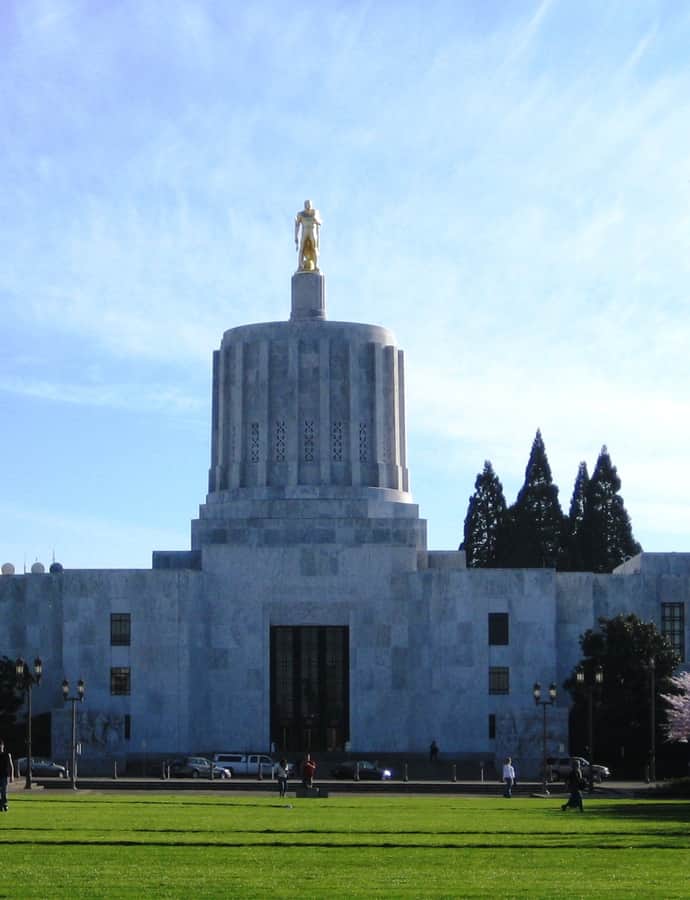

The Oregon State Capitol is the third building to house Oregon's state government in Salem, built after fires destroyed its two predecessors in 1855 and 1935. Erected from 1936 to 1938 by New York architects Trowbridge & Livingston with Francis Keally, its central section and 166-foot cupola cost $2.5 million, partly financed by the federal Public Works Administration during the Depression. Wings added later doubled the floor space to about 233,750 square feet for an additional $12.5 million. It was listed on the National Register of Historic Places on June 29, 1988.
the building
A capitol without a dome. Rather than the traditional domed rotunda of most American statehouses, the Capitol was conceived in Art Deco stripped classicism, with a 166-foot cupola standing in for the usual dome — a deliberate break from the domed-capitol tradition.
Marble inside and out. The building's exterior and much of its interior are marble, giving the stripped-classical forms a cool, monumental surface befitting the seat of the legislature and the governor's, secretary of state's, and treasurer's offices.
Grounds and gardens. The capitol grounds hold artwork, fountains, and plantings, including Oregon's state tree, the Douglas fir, and its state flower, the Oregon grape.
Built in two stages. The original central portion went up in 1936–38 for $2.5 million; the flanking wings came later at a cost of $12.5 million, doubling the building's floor space to roughly 233,750 square feet.
the style
The Capitol was designed in an Art Deco stripped-classical idiom rather than the domed, columned classicism typical of American statehouses — a notable departure that replaced the expected dome with a slender 166-foot cupola.
More on Art Decothe architect
The Capitol was designed by the New York firm Trowbridge & Livingston working with architect Francis Keally.
significance
The Oregon State Capitol was added to the National Register of Historic Places on June 29, 1988. It is the third capitol building on the site, following two predecessors lost to fires in 1855 and 1935.
nearby
- Elsinore Theatre
- Pacific Building
- Grand Theatre
- Christopher Paulus Building
- Marion County Housing Committee Demonstration House
- Oregon State Forester's Office Building