
Congregation Emanu-El
- Architect
- Arthur Brown, Jr.
- Year
- 1926
- Style
- Byzantine
- City
- San Francisco, CA
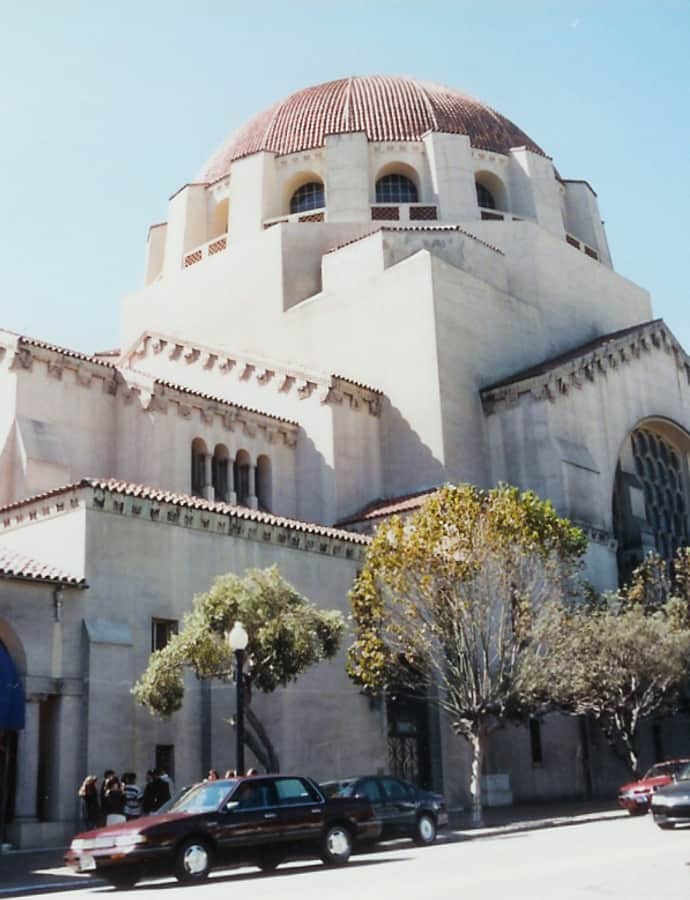

Congregation Emanu-El's current home was completed in 1926, designed by Arthur Brown Jr. in a Byzantine Revival style crowned by a large dome visible across Pacific Heights. The congregation traces back to 1849, when a small group of Jewish traders held the first Jewish service on the West Coast in a tent during the Gold Rush; a charter followed in 1851. Today it remains one of the three oldest Jewish congregations in California and one of the largest in the United States.
the building
The dome. The building's defining feature, visible from the street, is its large dome, rendered in the rounded, mosaic-toned vocabulary of Byzantine Revival architecture rather than the Gothic or Romanesque modes more common among American synagogues of the era.
A congregation of firsts. In 1877, Rabbi Elkan Cohn led Emanu-El as the first congregation in the American West to join the Reform movement. In 1884, Julie Rosewald became the country's first female cantor when she took the pulpit here, serving until 1893.
the style
Brown designed the synagogue in a Byzantine Revival mode, a departure from the Gothic and Romanesque styles typically used for American synagogues of the period. The result is dominated by a large dome that reads from the sidewalk as much like a Mediterranean basilica as a civic monument.
More on Byzantinethe architect
Arthur Brown Jr. was among San Francisco's most prominent architects working in the early twentieth century, commissioned here to design the congregation's Byzantine Revival home, completed in 1926.
significance
Congregation Emanu-El is one of the three oldest Jewish congregations in California and one of the largest Jewish congregations in the United States, and remains a significant gathering place for the Bay Area's Jewish community.
nearby
- Roos House
- Julian Waybur House
- Swedenborgian Church
- Conservatory of Flowers
- M. H. de Young Memorial Museum
- California Academy of Sciences building