
Radisson Lackawanna Station Hotel
- Architect
- Kenneth MacKenzie Murchison
- Year
- 1983
- Style
- Neoclassical
- City
- Scranton, PA
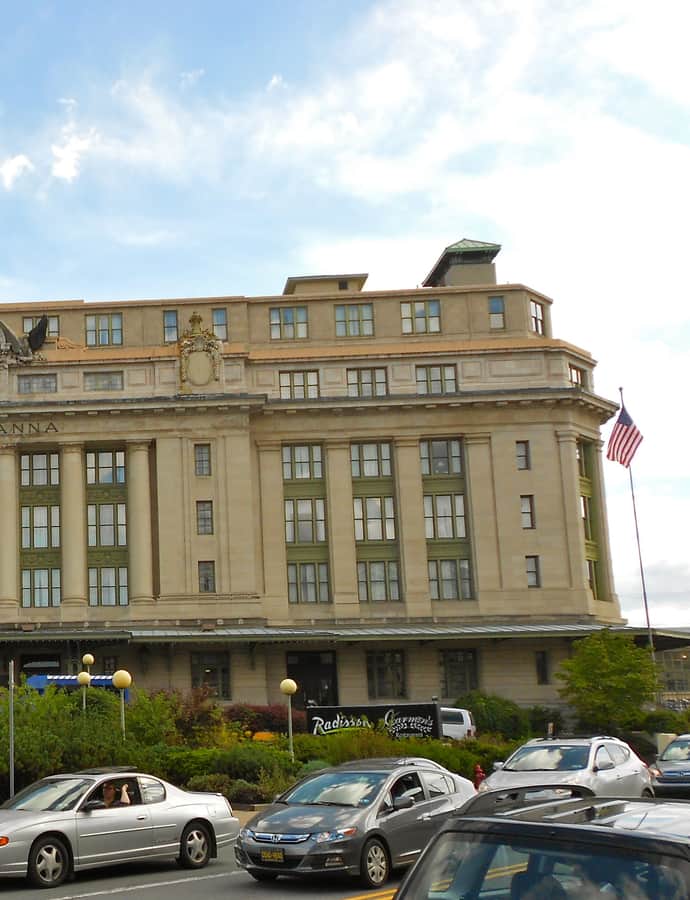

Built in 1908 as the Delaware, Lackawanna and Western Railroad Station, this French Renaissance-style building was commissioned by railroad president William Truesdale to replace an outgrown brick station and to house the railroad's offices. New York architect Kenneth MacKenzie Murchison designed it in a neoclassical style modeled on the Ecole des Beaux-Arts in Paris. The station closed in 1970, was added to the National Register of Historic Places in 1977, and was renovated into a hotel that reopened in 1983.
the building
A grander replacement station. Truesdale ordered the new station built about seven blocks east of the old Lackawanna Avenue depot, at 700 Lackawanna Avenue, combining passenger facilities with railroad offices in a single far larger structure.
Beaux-Arts training on display. Murchison executed the design in a neoclassical style reminiscent of the Ecole des Beaux-Arts in Paris, where he had trained, giving the station its formal, monumental character.
Station to hotel. After closing as a station in 1970, the building was renovated and reopened as a hotel in 1983, retaining its original clocks, doors, fountains, stairs, ceilings, and walls.
the style
The building is described in neoclassical terms reminiscent of the Ecole des Beaux-Arts, though also characterized as French Renaissance in style — a grand civic vocabulary chosen to signal the railroad's ambitions for its Scranton terminal.
More on Neoclassicalthe architect
Kenneth MacKenzie Murchison was a New York architect and noted railroad station designer, commissioned directly by Delaware, Lackawanna and Western Railroad president William Truesdale for this station.
significance
Listed on the National Register of Historic Places on December 6, 1977, after the station closed in 1970; the building was then converted into a hotel, reopening in 1983 with much of its original interior fabric intact.
nearby
- William J. Nealon Federal Building and United States Courthouse
- Dime Bank Building
- Scranton Chamber of Commerce Building
- St. Peter's Cathedral
- Scranton Cultural Center
- Albright Memorial Building