
Hall of Languages
- Architect
- Horatio Nelson White
- Year
- 1873
- Style
- Second Empire
- City
- Syracuse, NY
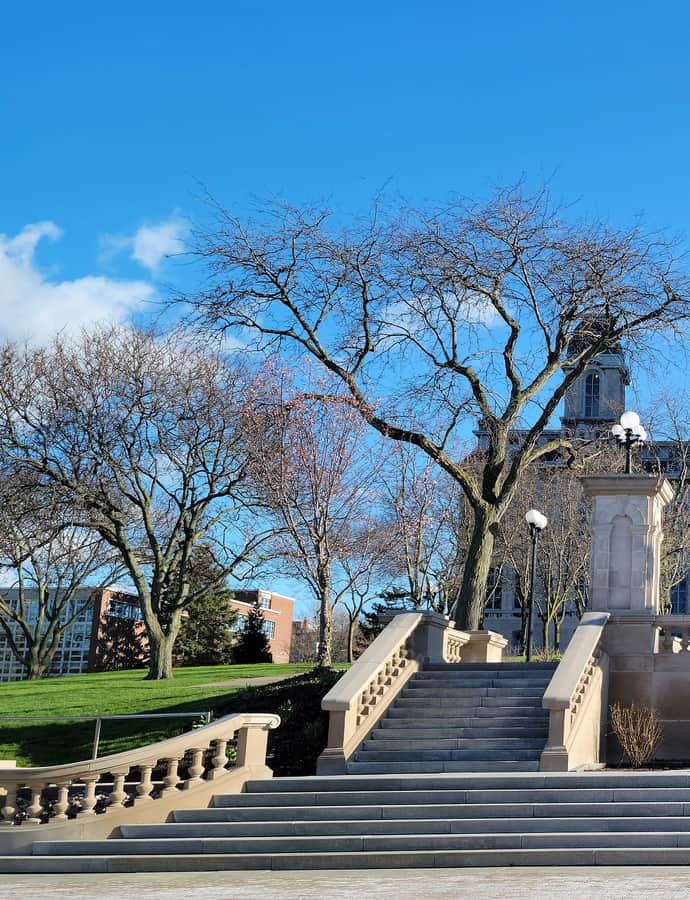

The Hall of Languages was the first building on the Syracuse University campus, originally housing the entire university. Designed by Horatio Nelson White in the Second Empire style and built in 1871–73, its cornerstone was laid August 31, 1871 by Jesse Truesdell Peck, and it was dedicated May 8, 1873 by Bishop Edmund S. James. It was home to the College of Liberal Arts, later the College of Arts and Sciences, and remains an iconic symbol of the university.
the building
Three towers, built in two phases. The original building had only the east and west towers; the central tower was added later, in 1886, giving the Hall of Languages its now-familiar three-cupola silhouette.
Limestone and cast iron. The building is made of Onondaga limestone and wood framing with interior cast-iron columns, materials that anchored it as a permanent civic-scaled presence on the young campus.
Modeled on the Gridley Building. White styled the Hall of Languages after his own Gridley Building in Downtown Syracuse, carrying a design he had already used downtown up onto the new university campus.
the style
The Hall of Languages was built in the Second Empire style, most visible in its mansard-roofed towers, an uncommon style choice that gives the building its distinctive silhouette on the campus quad.
More on Second Empirethe architect
Horatio Nelson White was a documented notable regional architect; he also designed the Gridley Building in Downtown Syracuse, which served as the model for the Hall of Languages, and Grace Episcopal Church near the university.
significance
The Hall of Languages was listed on the National Register of Historic Places in 1973 and is a contributing property to that listing. It has been prominently displayed as a representation of Syracuse University. Its interior was completely rebuilt in 1978–79.
nearby
- Syracuse University Gateway
- Newhouse Communications Center I
- Maxwell Hall
- Crouse College
- Bird Library
- 703 Walnut Ave