
Georgetown Car Barn
- Architect
- Waddy Butler Wood
- Year
- 1895
- Style
- Romanesque Revival
- City
- Washington, DC
- Collection
- romanesque revival
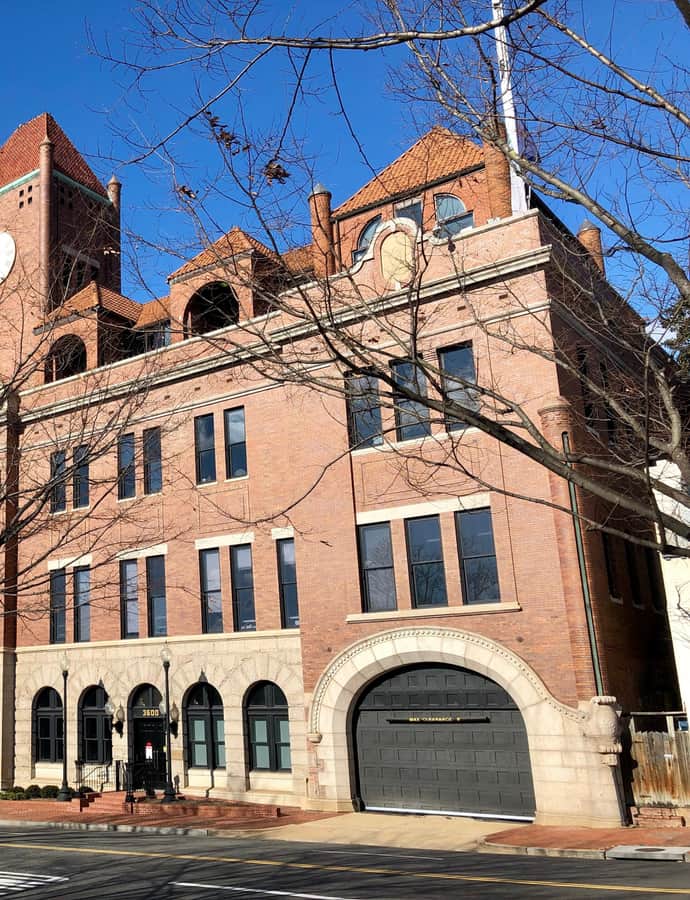

Built between 1895 and 1897 by the Capital Traction Company, the Georgetown Car Barn served as a union terminal where several Washington and Virginia streetcar lines converged, and as the terminal for the city's only cable car system. Architect Waddy Butler Wood designed the original Romanesque Revival structure, which was substantially altered in a 1911 renovation that reworked the facade and gutted the interior.
the building
The Exorcist Steps. The steep stairway connecting M Street to Prospect Street was built alongside the Car Barn during its original construction. It later gained fame as the steps used in the climactic scene of William Friedkin's 1973 film The Exorcist, and still carries that name today.
Cable cars to electric. The Car Barn was built to store and dispatch streetcars, including Washington's only cable car line. Almost as soon as it opened, Capital Traction converted its lines to electric power, and the building was modified to suit the new technology rather than the cable system it was designed around.
the style
Wood's original design was Romanesque Revival, but the building's public face today is not entirely the one he built. A major 1911 renovation reworked the facade and gutted the interior, altering much of the original Romanesque Revival scheme.
More on Romanesque Revivalsignificance
The Car Barn is a National Register of Historic Places listed property and contributing building, and is also listed on the District of Columbia Inventory of Historic Sites.
nearby
- Prospect House (Lingan-Templeman House)
- Washington Canoe Club
- Forrest-Marbury House
- Lauinger Library
- Georgetown University, Healy Hall
- Georgetown University, Old North