
Lincoln Memorial
- Architect
- Henry Bacon
- Year
- 1922
- Style
- Greek Revival
- City
- Washington, DC
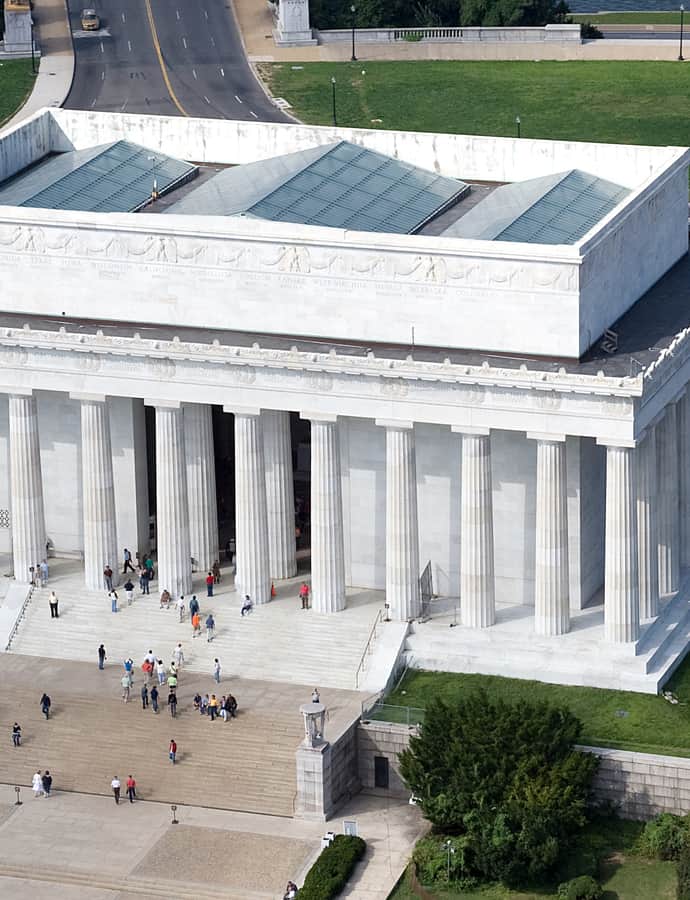

The Lincoln Memorial, dedicated May 30, 1922, honors the 16th president in the form of a Doric-columned classical temple designed by architect Henry Bacon. Daniel Chester French designed the enormous interior statue of Lincoln, carved in marble by the Piccirilli brothers, while Jules Guerin painted the flanking murals and Royal Cortissoz wrote the epitaph above the statue. Beyond its original memorial purpose, the building became a recurring stage for the nation's fights over race and civil rights.
the building
The Lincoln statue. Daniel Chester French designed the monumental seated statue of Lincoln in 1920, and it was carved in marble by the Piccirilli brothers. Jules Guerin painted the murals on either side of it, and the epitaph above the statue was composed by Royal Cortissoz.
Words on the walls. The memorial's interior walls are inscribed with two of Lincoln's own speeches, the Gettysburg Address and his second inaugural address, placing his words alongside his statue rather than leaving the building as a silent monument.
1963 March on Washington. On August 28, 1963, Martin Luther King Jr. delivered his "I Have a Dream" speech from the memorial's steps at the close of the March on Washington for Jobs and Freedom, cementing the building's second life as a stage for civil rights history.
the style
Henry Bacon modeled the memorial as a classical Doric temple, its exterior lined with fluted Doric columns in the manner of a Greek shrine, casting Lincoln's memory in the architectural language of ancient democracy rather than the domes and porticos used elsewhere on the Mall.
More on Greek Revivalthe architect
Henry Bacon designed the Lincoln Memorial, working alongside sculptor Daniel Chester French, who designed the interior statue, and muralist Jules Guerin, who painted its murals.
significance
The Lincoln Memorial is listed on the National Register of Historic Places and the District of Columbia Inventory of Historic Sites. It has been a major tourist attraction since it opened and has repeatedly served as a symbolic site for speeches and rallies on race relations and civil rights, most famously the 1963 March on Washington.
nearby
- United States Institute of Peace Headquarters
- American Institute of Pharmacy (American Pharmacists Association)
- National Academy of Sciences
- Eccles Building
- Harry S. Truman Federal Building
- United States Public Health Service Building