
National Museum of the American Indian
- Architect
- Douglas Cardinal
- Year
- 1989
- City
- Washington, DC
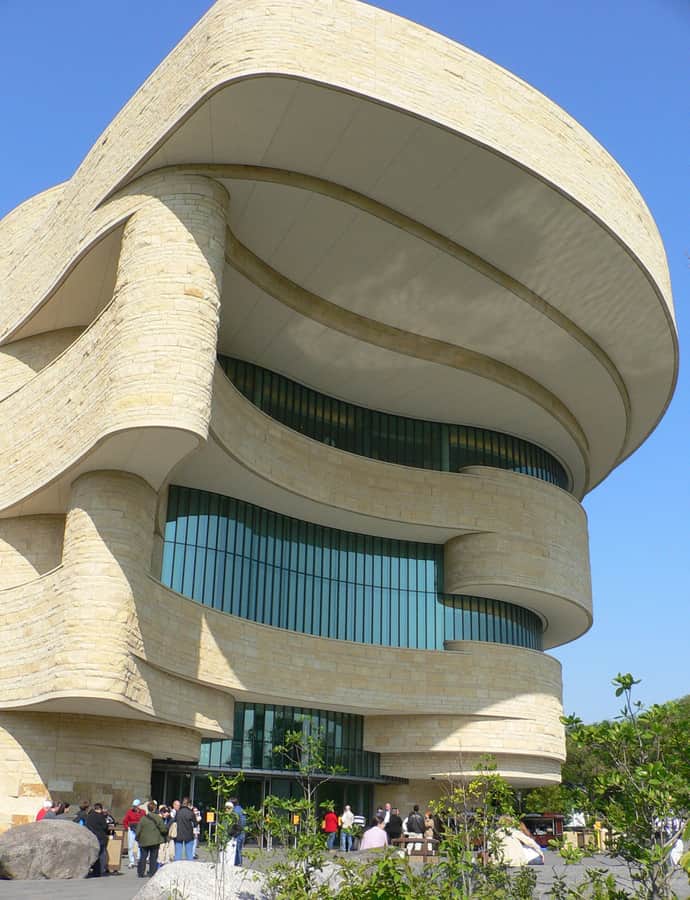

The National Museum of the American Indian, part of the Smithsonian Institution, opened on the National Mall on September 21, 2004, at Fourth Street and Independence Avenue SW. It was designed by Douglas Cardinal, an Indigenous architect. The museum's roots trace to a private Museum of the American Indian founded in New York in 1916, which became part of the Smithsonian in 1989.
the building
A curving, sculptural facade. Rather than the rectilinear classicism of its Mall neighbors, the building takes a distinctive curvilinear form, giving it a highly visible, sculptural presence among the Mall's museums.
the architect
Douglas Cardinal is a noted Indigenous architect; this museum, built for the Smithsonian, is recognized for its departure from the typical rectilinear museum forms found elsewhere on the National Mall.
significance
The museum operates alongside two related Smithsonian facilities: the George Gustav Heye Center at the Alexander Hamilton U.S. Custom House in New York City, opened in 1994, and the Cultural Resources Center in Suitland, Maryland. Advocacy for the museum's creation began in 1982 at the Kennedy Center's Night of the First Americans event.
nearby
- Wilbur J. Cohen Federal Building
- National Air and Space Museum
- Railroad Retirement Board (Mary Switzer Building)
- East Building of the National Gallery of Art
- National Gallery of Art
- E. Barrett Prettyman United States Courthouse