
Octagon House (John Tayloe House)
- Architect
- William Thornton
- Year
- 1799
- Style
- Federal
- City
- Washington, DC
- Collection
- federal washington
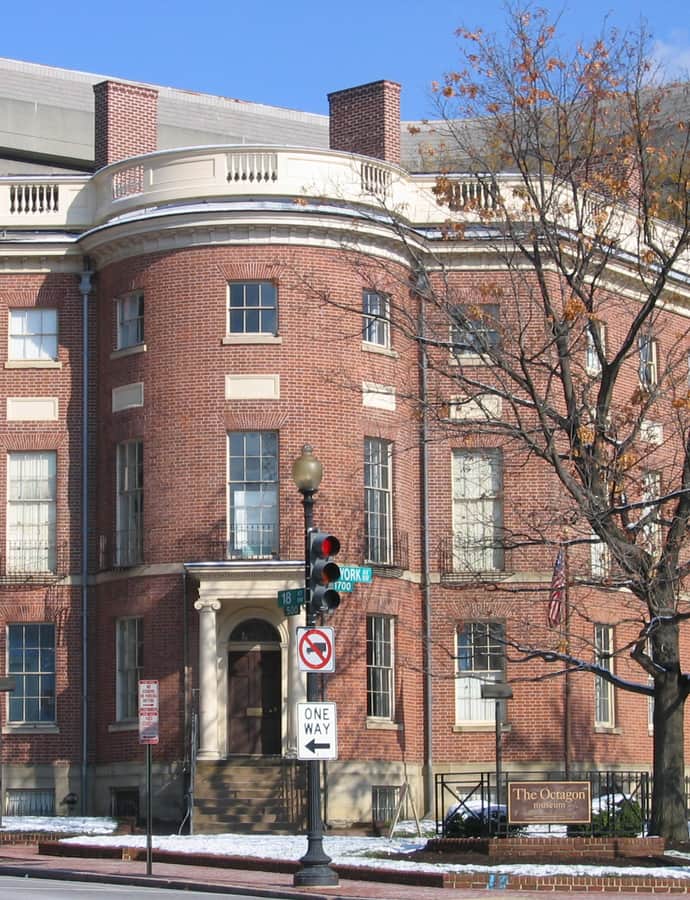

The Octagon House was built in 1799 by architect William Thornton, the first architect of the U.S. Capitol, for John Tayloe III, then the wealthiest planter in the country, at the urging of Tayloe's new in-law George Washington. Its most famous moment came in September 1814, after the British burned the White House during the War of 1812: Tayloe lent the house to President James Madison and Dolley Madison for six months to serve as the Executive Mansion. It is one of only three houses that have served as a U.S. presidential residence and still stand today, alongside the White House and Blair House.
the building
A temporary White House. After British troops burned the White House in 1814, John Tayloe III lent the Octagon House to President James Madison and Dolley Madison for six months as the Executive Mansion. It remains one of only three surviving buildings that have ever served as a U.S. presidential residence, along with the White House and Blair House.
Built at Washington's urging. John Tayloe III built the house in 1799 partly at the behest of George Washington himself, after Tayloe's sister Sarah married William Augustine Washington, a nephew of the general and future president.
the style
The Octagon House is a Federal-style building, designed by William Thornton in 1799 in the restrained, classically inflected idiom of the early American republic.
More on Federalthe architect
William Thornton, the Octagon's architect, was the first architect of the U.S. Capitol, giving the house a direct link to the design of the nation's founding-era government buildings.
significance
The Octagon House is a National Historic Landmark and DC Historic Landmark (#L_0266), also listed on the National Register of Historic Places, recognized in part for its role as a temporary presidential residence after the burning of the White House.
nearby
- Corcoran Gallery of Art
- U.S. Civil Service Commission Building
- Winder Building
- American National Red Cross
- Eisenhower Executive Office Building
- Constitution Hall