
Supreme Court
- Architects
- Cass Gilbert Hermon Atkins MacNeil Robert Ingersoll Aitken
- Year
- 1935
- Style
- Neoclassical
- City
- Washington, DC
- Collection
- the city beautiful
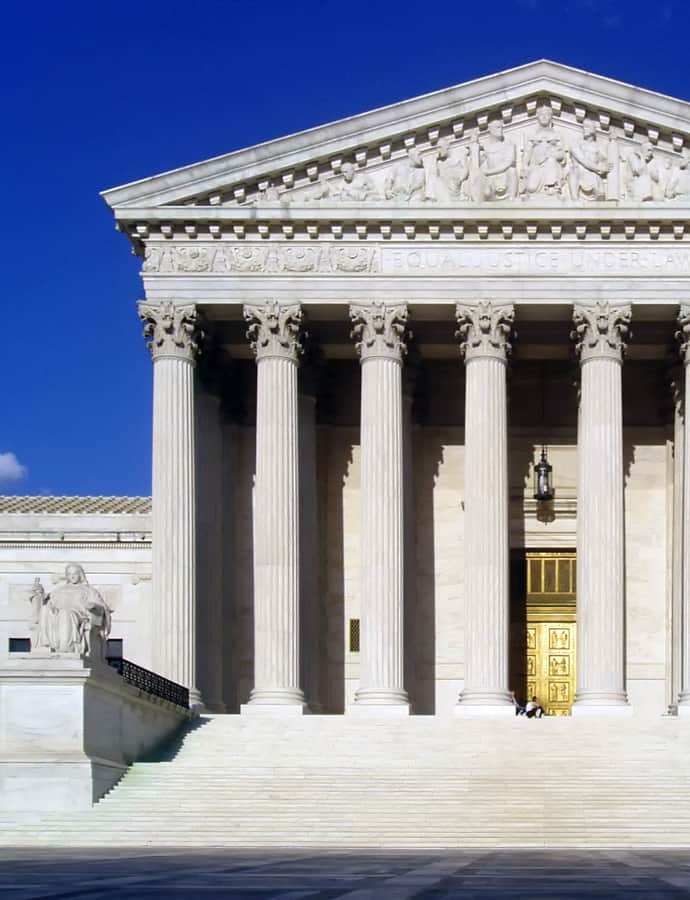

The Supreme Court Building gave the nation's highest court its first permanent home, an idea President William Howard Taft pushed for starting in 1912 and finally won approval for in 1929, after he had become Chief Justice. Taft died before it was built; construction ran from 1932 to 1935 under his successor, Chief Justice Charles Evans Hughes. Taft's friend Cass Gilbert designed the neoclassical building, sited one block east of the Capitol and just north of the Library of Congress.
the building
The sculptural program. The building's sculptural program was carried out by Hermon Atkins MacNeil and Robert Ingersoll Aitken, whose work forms the monumental figures and reliefs that give the Beaux-Arts facade its narrative weight.
A friend's commission. Cass Gilbert got the job in part through his friendship with William Howard Taft, the former president and sitting Chief Justice who had spent nearly two decades pressing Congress for a dedicated Supreme Court building before it was finally authorized in 1929.
the style
Gilbert designed the Court in a neoclassical, Beaux-Arts idiom, giving the newest branch of federal government a facade that reads as solidly and permanently classical as the Capitol and Library of Congress that flank it.
More on Neoclassicalthe architect
Cass Gilbert was a friend of William Howard Taft, which helped bring him the Supreme Court commission. Construction proceeded under Chief Justice Charles Evans Hughes after Taft, who had championed the building since 1912, died before it was completed in 1935.
significance
The Supreme Court Building was designated a National Historic Landmark on May 4, 1987, and is also listed on the District of Columbia Inventory of Historic Sites. It remains the official workplace of the Chief Justice and the eight associate justices, managed by the Architect of the Capitol.
nearby
- Hiram W. Johnson House
- Sewall-Belmont House (Nat'l Woman's Party Headquarters)
- Folger Shakespeare Library
- Library of Congress
- Thomas Jefferson Building
- Senate Office Building (Russell Senate Office Building)