
Hammond–Harwood House
- Architect
- William Buckland
- Year
- 1774
- Style
- Georgian
- City
- Annapolis, MD
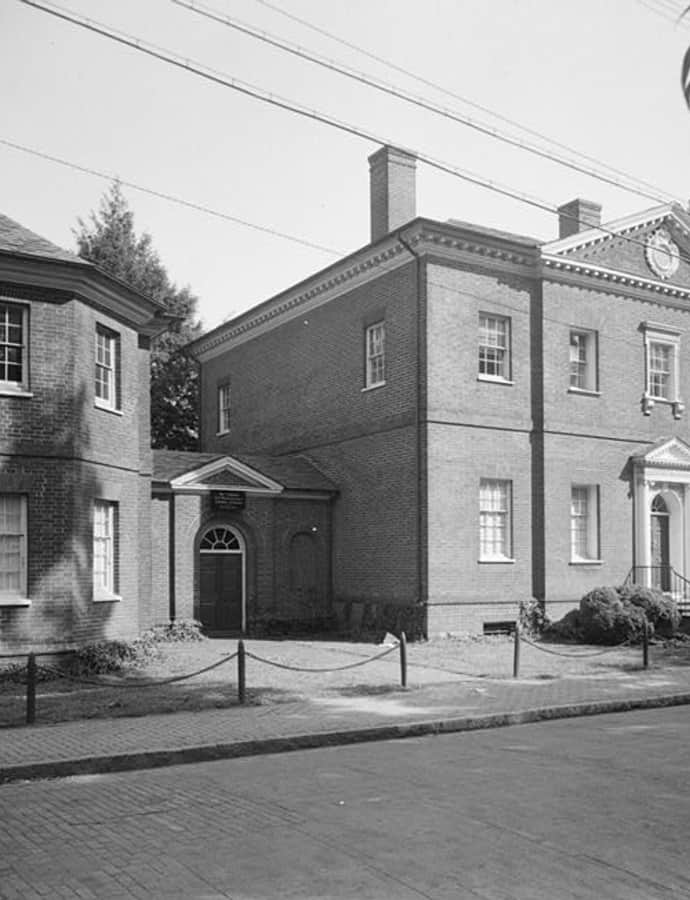

The Hammond-Harwood House, built in 1774 at 19 Maryland Avenue, is one of the premier surviving colonial houses from the British colonial period in America and one of the only works of colonial academic architecture designed principally from a plate in Andrea Palladio's I Quattro Libri dell'Architettura. Architect William Buckland designed it in 1773-74 for wealthy farmer Matthias Hammond of Anne Arundel County, modeling it on the Villa Pisani in Montagnana, Italy.
the building
Modeled on Villa Pisani. The house's design was drawn from Book II, Chapter XIV of Palladio's Four Books of Architecture, depicting the Villa Pisani, making it one of the few American colonial buildings designed directly from a Palladian plate.
the style
The house is Palladian in design, drawn directly from Andrea Palladio's published plates, and Georgian in its overall colonial brick construction.
More on Georgianthe architect
William Buckland designed the Hammond-Harwood House in 1773-74; he died in November or December 1774, shortly after most of the house was completed.
significance
The Hammond-Harwood House was designated a National Historic Landmark in 1960 and is now managed by a non-profit organization as a museum. Owner Matthias Hammond likely never occupied the house, having left Annapolis for his family's country estate in 1776.