
Charleston City Hall
- Architect
- Gabriel Manigault
- Year
- 1801
- Style
- Neoclassical
- City
- Charleston, SC
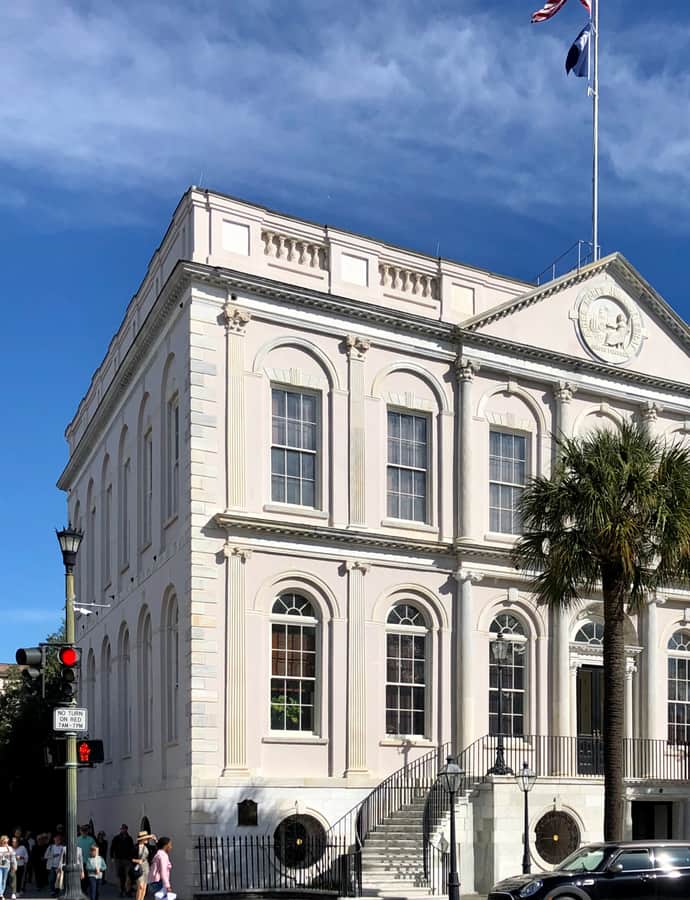

Charleston City Hall began life in 1801 as the local branch of the First Bank of the United States, built by Gabriel Manigault on a Broad Street corner that had been a beef market until fire destroyed it in 1796. The city bought the building and moved City Hall in in 1819, making it the second longest continuously serving city hall in the country, behind only New York's.
the building
Raising the bank. The corner parcel was conveyed to the Charleston branch of the First Bank of the United States in 1800, and construction was overseen by carpenters Edward Magrath and Joseph Nicholsen and mason Andrew Gordon. It was this bank building the city later purchased and converted into City Hall.
The 1882 rebuild. Repairs in 1882 pursued three goals: a new roof, room for every city office, and easier public access. Contractor Henry Oliver was paid $14,000 to add a metal roof, stucco over the formerly exposed brickwork, and gut the interior to build the City Council chambers still used on the second floor. During the work, the mayor operated out of Market Hall while other officials scattered to the Union Bank on East Bay Street and the Mills House.
the style
The Neoclassical design reflects the building's origin as a bank rather than a civic hall, dressing the seat of city government in the same restrained, symmetrical vocabulary Gabriel Manigault used for the early Federal-era institutions of Charleston's financial and civic elite.
More on Neoclassicalsignificance
Since the city moved in in 1819, this has been the second longest continuously serving city hall building in the United States, outlasted only by New York City's.
nearby
- Charleston County Courthouse
- Fireproof Building
- St. Michael's Episcopal Church
- Hibernian Hall
- U. S. Post Office and Courthouse (Charleston)
- Heyward-Washington House