
Hibernian Hall
- Style
- Greek Revival
- City
- Charleston, SC
- Collection
- antebellum charleston
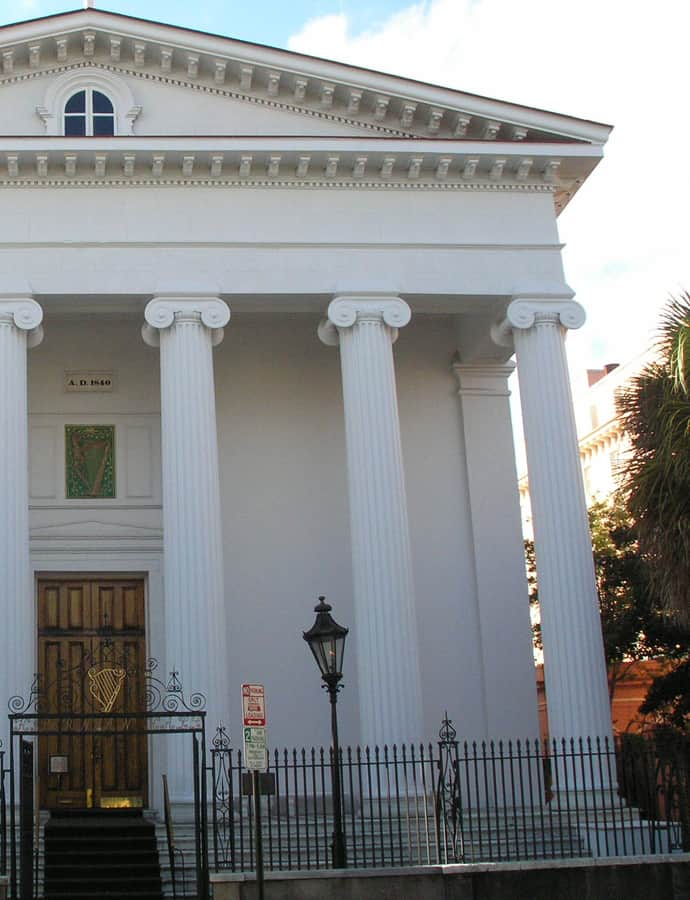

Hibernian Hall at 105 Meeting Street, built in 1840, is the only work in Charleston by the Philadelphia architect Thomas Ustick Walter, designed for the Hibernian Society, an Irish benevolent society organized in 1801. Its wrought-iron gates were made by the German-American ironworker Christopher Werner. The hall is nationally significant as the site of the 1860 Charleston Convention, where the Democratic Party split over slavery and failed to nominate a candidate, helping ensure the Republican Party's victory that November. It was declared a National Historic Landmark in 1973.
the building
Walter's only Charleston work. Walter, of Philadelphia, designed Hibernian Hall in 1840 in the Greek Revival style — the only building of his in Charleston, commissioned by the Hibernian Society, an Irish benevolent society founded in 1801.
Christopher Werner's iron gates. The hall's wrought-iron entrance gates were made by Christopher Werner, a German-American master ironworker active in Charleston.
the style
Hibernian Hall is a fine example of Greek Revival architecture, built at the Four Corners of Law intersection for an Irish benevolent society.
More on Greek Revivalthe architect
Thomas Ustick Walter, based in Philadelphia, designed Hibernian Hall in 1840 — his only architectural work in Charleston.
significance
Hibernian Hall is nationally significant as the site of the 1860 Charleston Convention, where a Democratic Party divided over slavery failed to choose a presidential nominee, a split that helped ensure the Republican Party's victory in the 1860 election. It was designated a National Historic Landmark in 1973 and continues to be used as a function and meeting space.
nearby
- Fireproof Building
- Charleston County Courthouse
- Charleston City Hall
- St. Michael's Episcopal Church
- U. S. Post Office and Courthouse (Charleston)
- Circular Congregational Church