
City Market
- Architect
- Edward Brickell White
- Style
- Greek Revival
- City
- Charleston, SC
- Collection
- antebellum charleston
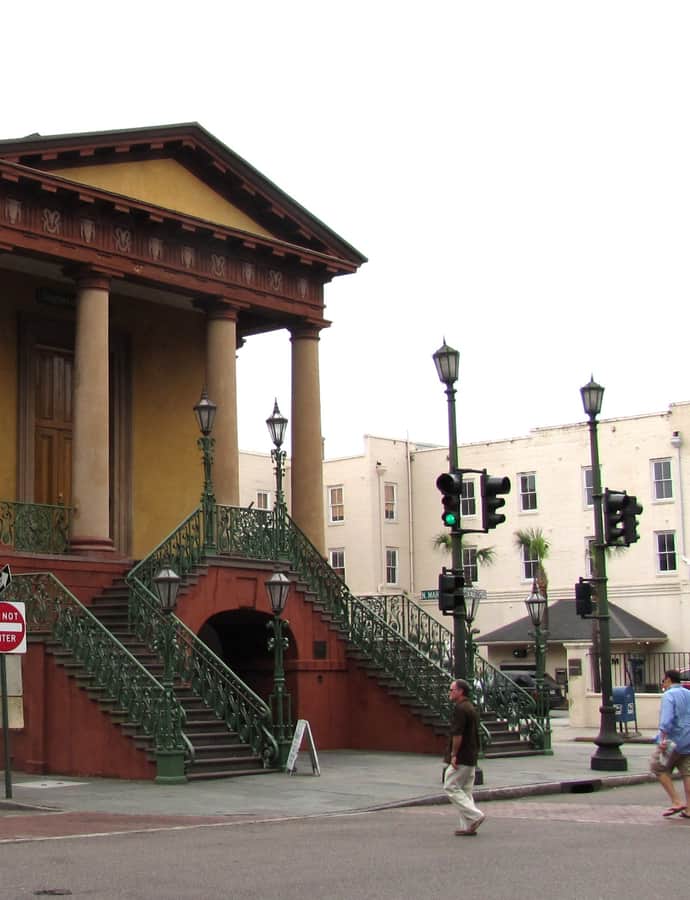

City Market began in the 1790s as the Centre Market, built to replace Charleston's Beef Market after it burned in 1796. It grew into a complex stretching four city blocks, from the architecturally significant Market Hall on Meeting Street through a continuous run of one-story market sheds ending at East Bay Street. Market Hall, added in the early 1840s and designed by Charleston architect Edward Brickell White, has been called a building of the highest architectural design quality, and the complex was listed on the National Register and designated a National Historic Landmark as Market Hall and Sheds.
the building
Market Hall. Added in the early 1840s to Edward Brickell White's Greek Revival design, Market Hall is the architectural centerpiece of the complex, praised as a building of the highest architectural design quality and the public face of the market on Meeting Street.
Not the slave market. City Market is frequently and mistakenly confused with the Old Slave Mart, a separate site where enslaved people were sold. Enslaved people were never sold at City Market itself, a distinction historians note as a common misconception.
the style
Market Hall is executed in the Greek Revival style, giving the market's principal public building a temple-fronted dignity at odds with the utilitarian sheds stretching behind it toward East Bay Street.
More on Greek Revivalsignificance
The complex was listed on the National Register of Historic Places as Market Hall and Sheds and further designated a National Historic Landmark.
nearby
- The Charleston Place
- Circular Congregational Church
- Powder Magazine
- Charleston Hotel
- Huguenot Church
- Dock Street Theatre