
Chicago Public Library/Cultural Center
- Architect
- Shepley, Rutan & Coolidge
- Year
- 1897
- Style
- Neoclassical
- City
- Chicago, IL
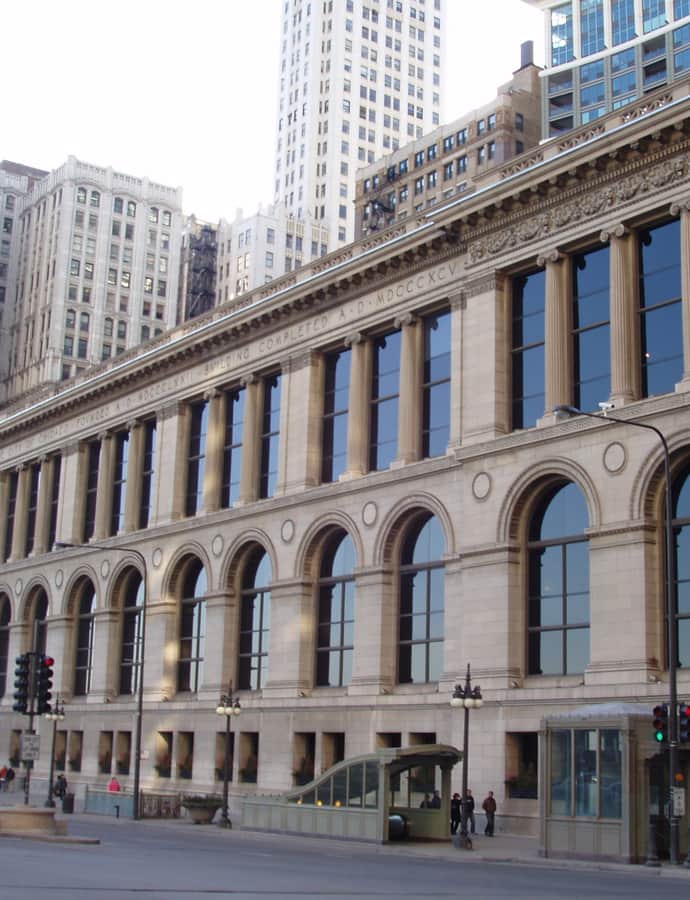

Completed in 1897 as the central Chicago Public Library and a memorial hall, this neoclassical building on Washington Street was designed by Shepley, Rutan & Coolidge, the successor firm to H.H. Richardson's practice. In 1978, at the urging of Cultural Affairs Commissioner Lois Weisberg, the city converted it into the Chicago Cultural Center — the nation's first free municipal cultural center — after the library moved out. It now serves as Chicago's official reception venue, where the mayor has welcomed presidents, royalty, and diplomats, and hosts more than 1,000 arts programs a year.
the building
Memorial hall origins. Before it held art exhibitions, the building doubled as a memorial hall alongside its role as the city's main library. That library function moved out in 1991, when Chicago's central collection relocated to the newly built, postmodern Harold Washington Library Center across the Loop.
Reception venue. The building functions as Chicago's official reception venue: the mayor has used it to host presidents, royalty, diplomats, and community leaders. It's also headquarters for the Chicago Children's Choir and stages more than 1,000 programs and exhibitions a year, ranging across performing, visual, and literary arts.
the style
Shepley, Rutan & Coolidge designed the building in the Neoclassical mode, the firm having grown out of H.H. Richardson's practice after his death. The style suited the building's original dual purpose as a monumental civic library and memorial hall facing Washington Street.
More on Neoclassicalthe architect
Shepley, Rutan & Coolidge was the successor firm to the practice of H.H. Richardson, one of the most influential American architects of the 19th century, continuing his commissions and reputation for monumental civic and institutional buildings after his death.
significance
Designated a Chicago Landmark (L-68) and listed on the National Register of Historic Places on November 5, 1976. As the nation's first free municipal cultural center, it's considered one of the most comprehensive arts showcases in the United States and one of Chicago's most popular attractions.
nearby
- Pittsfield Building
- Marshall Field and Company Building
- One North State
- Exelon Pavilions
- Jewelers Building
- Old Dearborn Bank Building