
One Detroit Center
- Architects
- Philip Johnson John Burgee
- Year
- 1993
- Style
- Postmodernism
- City
- Detroit, MI
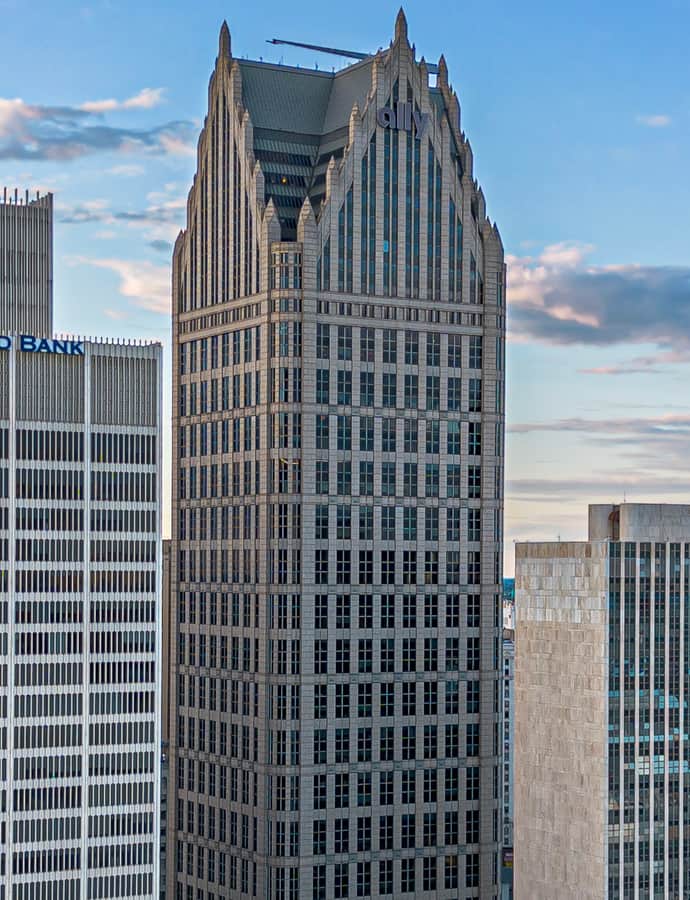

Ally Detroit Center, originally One Detroit Center, is a 43-story office skyscraper on Detroit's downtown skyline, rising 619 feet to rank as the third-tallest building in both Detroit and Michigan, behind the Renaissance Center and Hudson's Detroit. It was designed by Philip Johnson and John Burgee and built between 1991 and 1993, with 1,674,708 square feet of office space for tenants including Detroit law firms and PricewaterhouseCoopers. The tower is best known for topping its granite mass with a pair of Flemish-inspired neo-Gothic spires, a deliberate postmodern gesture meant to echo the historic skyline around it.
the building
Twin Gothic spires. The building's nickname, the 'twin gothic structure,' comes from the paired spires crowning the tower, oriented on both a north-south and an east-west axis, as recorded on a plaque along the Windsor waterfront park across the river. The spires became recognizable enough that miniature replicas of the building have been sold as Detroit souvenirs.
Granite construction. Beneath its Gothic-flavored crown, the tower is built mainly of granite, giving the postmodern design a weight and solidity that grounds the historicist detailing at the top.
A working downtown tower. The building was built to house office tenants rather than serve as a monument — it holds numerous law firms and PricewaterhouseCoopers, along with retail space, a restaurant, and a gym, making it a fully occupied piece of Detroit's business district.
the style
Johnson and Burgee designed the tower in the postmodern idiom the pair helped define nationally, layering historical references onto a modern high-rise rather than stripping them away. Here that meant crowning an otherwise contemporary granite office tower with Flemish-inspired neo-Gothic spires, a move intended to let the building converse with Detroit's older, more ornamented skyline instead of standing apart from it.
More on Postmodernismthe architect
Philip Johnson and John Burgee worked as partners and were influential figures in the postmodern movement in American architecture; Ally Detroit Center is documented as one of their prominent designs from that era.
significance
The building won an Award of Excellence for its design in 1996 and remains the third-tallest building in both Detroit and Michigan. Its twin-spired silhouette has become recognizable enough to be reproduced as a souvenir replica of the city.
nearby
- Guardian Building
- Vinton Building
- One Woodward Avenue
- First National Building
- Ford Building
- Buhl Building