
Mississippi State Capitol
- Architect
- Theodore Link
- Style
- Beaux-Arts
- City
- Jackson, MS
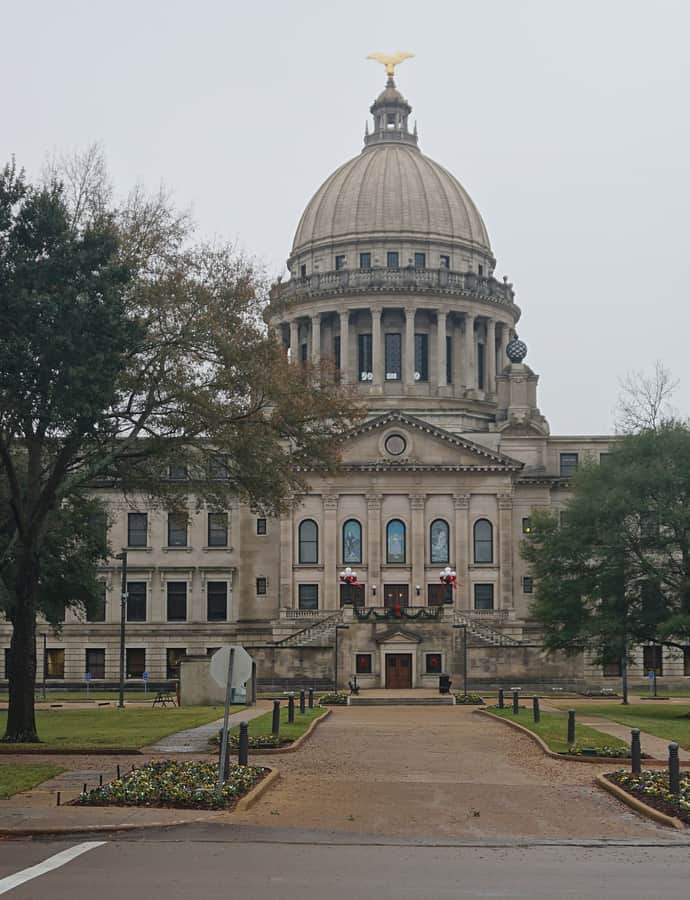

The Mississippi State Capitol, known as the "New Capitol," has served as the seat of state government since 1903, replacing the old Mississippi State House. Governor Andrew Houston Longino pushed the project through the Legislature starting in 1900, and fourteen architects submitted plans in a national contest advertised in five major cities. Theodore Link's Beaux-Arts design won, with Bernard R. Green, architect of the Library of Congress's Thomas Jefferson Building, brought in to oversee the work. It was designated a Mississippi Landmark in 1986 and a National Historic Landmark in 2016.
the building
A national design contest. Rather than simply hire a local architect, the state advertised the commission in newspapers across five prominent cities and drew fourteen competing submissions. Theodore Link's Beaux-Arts scheme won out, and Bernard R. Green, who had just designed the Library of Congress's Thomas Jefferson Building in Washington, D.C., was brought on to oversee construction.
the style
Link designed the Capitol in the Beaux-Arts style, the grand civic idiom trained architects of the era used to signal that a state government belonged among the great institutions of the country. It is a textbook example of the style applied to a state capitol.
More on Beaux-Artsthe architect
Theodore Link won the commission through a national contest that drew fourteen submissions. Bernard R. Green, the architect/engineer behind the Library of Congress's Thomas Jefferson Building, was hired to oversee construction of Link's design.
significance
The Capitol was added to the National Register of Historic Places in 1969, named a Mississippi Landmark in 1986, and designated a National Historic Landmark in 2016. It has been the seat of Mississippi's government continuously since 1903.
nearby
- Virden-Patton House
- Cathedral of St. Peter the Apostle
- Mississippi Governor's Mansion
- Old Mississippi State Capitol
- St. Andrew's Cathedral
- Jackson City Hall