
Nebraska State Capitol
- Architect
- Bertram Goodhue
- Year
- 1932
- Style
- eclecticism
- City
- Lincoln, NE
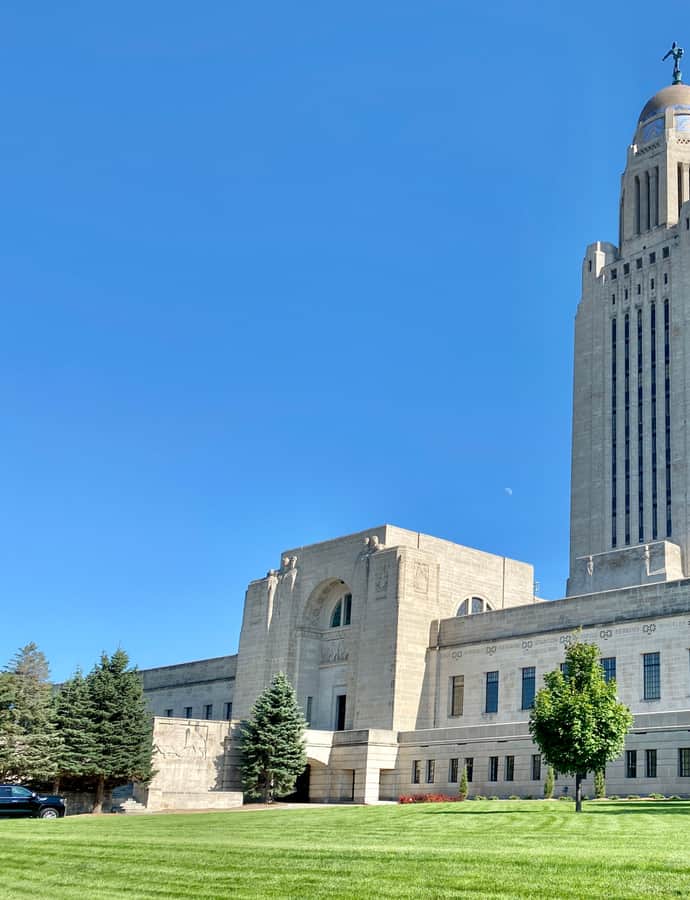

The Nebraska State Capitol is the seat of Nebraska's government, designed by New York architect Bertram Grosvenor Goodhue in 1920 and built of Indiana limestone from 1922 to 1932. It houses the state's executive and judicial offices along with the Nebraska Legislature, the only unicameral state legislature in the United States. Goodhue's design was the first state capitol to incorporate a functional tower, a solution to what he called the problem of a level country needing 'altitude or beacon effect.'
the building
The tower. At 400 feet, the capitol's tower is the tallest building in Nebraska outside of Omaha and can be seen twenty miles away. Goodhue's decision to top a traditional domed-capitol plan with a vertical tower was a break from precedent among American statehouses, giving Lincoln's flat landscape a landmark visible for miles.
The base. The tower rises from a three-story, 437-foot square base built of Indiana limestone. This base houses the offices most frequently visited by the public, with the main floor on the second level.
The grounds. The capitol grounds were designed in 1932 by Ernst H. Herminghaus, and in 1997 the National Park Service extended the building's National Historic Landmark designation to cover them as well.
the style
Goodhue worked in an eclectic idiom that fused a classical capitol plan with a soaring central tower, a combination without real precedent among American statehouses. The style let the building read simultaneously as a seat of government and as a beacon over the surrounding prairie.
the architect
Bertram Grosvenor Goodhue was a New York architect who designed the capitol in 1920, twelve years before its completion. The building stands as one of his best-known works, distinguished by its unprecedented tower-capitol design.
significance
The National Park Service designated the Nebraska State Capitol a National Historic Landmark in 1976, and extended that designation in 1997 to include the surrounding grounds designed by Ernst H. Herminghaus.
nearby
- Nebraska Governor's Mansion
- William H. Ferguson House
- Thomas P. Kennard House
- Scottish Rite Temple
- Masonic Temple
- Lyman Terrace