
Los Angeles Union Station
- Year
- 1939
- Style
- Spanish Colonial Revival
- City
- Los Angeles, CA
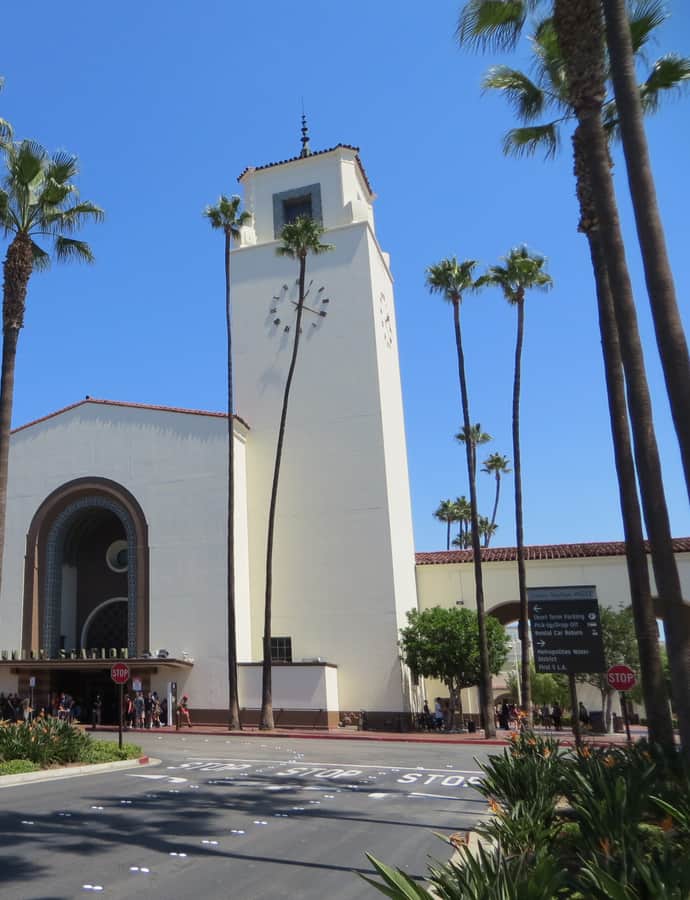

Los Angeles Union Station opened in May 1939 as the Los Angeles Union Passenger Terminal, consolidating service from the Santa Fe, Southern Pacific, and Union Pacific railroads into a single depot and replacing the older La Grande, Central, and Salt Lake stations. Approved through a controversial 1926 ballot measure and built through the 1930s, it was conceived on a grand scale and became known as the "Last of the Great Railway Stations" built in the United States. It remains the largest passenger rail terminal in the Western United States.
the building
Three styles in one. The terminal's design combines Art Deco, Mission Revival, and Streamline Moderne elements, cataloged more broadly as Spanish Colonial Revival architecture, an eclectic mix built to serve as both a modern transportation hub and a civic landmark.
One roof, three railroads. Union Station consolidated service from the Santa Fe, Southern Pacific, and Union Pacific railroads, replacing the separate La Grande Station, Central Station, and Salt Lake Station and ending the era of Los Angeles's competing rail depots.
the style
The station is cataloged as an example of Spanish Colonial Revival architecture, though its design in fact blends three styles: Art Deco, Mission Revival, and Streamline Moderne, brought together in one monumental terminal building.
More on Spanish Colonial Revivalsignificance
Union Station was placed on the National Register of Historic Places in 1980 and is also a Los Angeles Historic-Cultural Monument. It remains the largest passenger rail terminal in the Western United States and its busiest railroad station, serving nearly 110,000 passengers a day, and ranks as Amtrak's fifth-busiest station nationally and the thirteenth-busiest in North America.
nearby
- Pico House
- Terminal Annex
- Spring Street Courthouse
- Los Angeles City Hall
- Los Angeles County Hall of Records
- Caltrans District 7 Headquarters