
The Town House
- Architect
- Norman W. Alpaugh
- Year
- 1929
- Style
- Spanish Colonial Revival
- City
- Los Angeles, CA
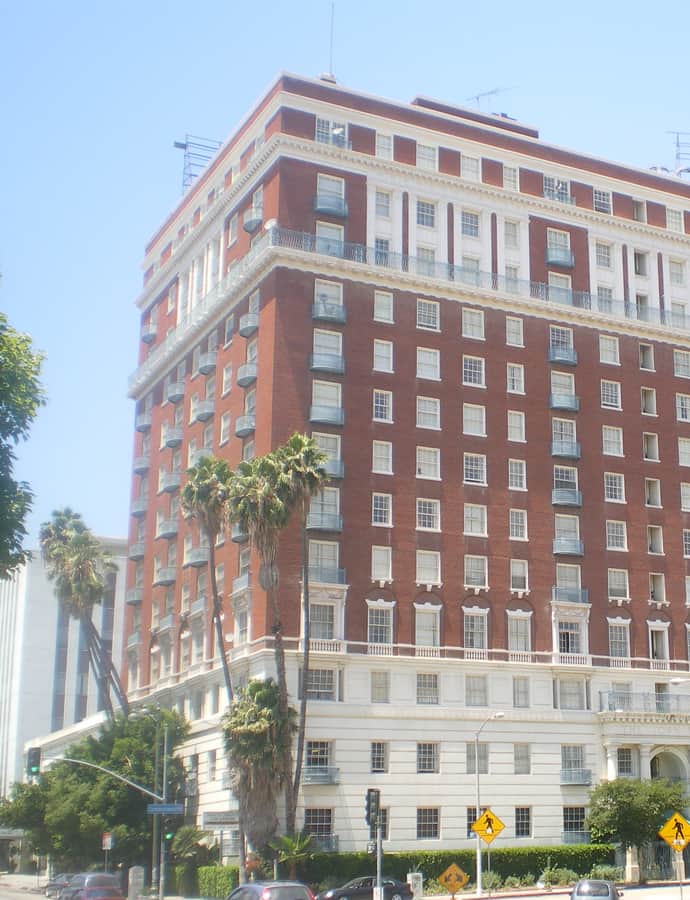

The Town House was developed by oil magnate Edward Doheny as one of the most luxurious apartment-hotels in Southern California, designed by Norman W. Alpaugh and built for $3 million on Wilshire Boulevard next to Lafayette Park. It opened September 11, 1929, in a Mediterranean Revival idiom that the building's own record calls a very late example of the Beaux Arts style, wrapped in a brick and terra cotta facade with classical detailing.
the building
Apartment-hotel model. Built as an 'apartment hotel' for affluent long-term residents rather than overnight guests, its early tenants included Byron H. Canfield, board chairman of Scripps-Canfield newspapers.
the style
The building mixes Mediterranean Revival massing with late Beaux Arts classical detailing in brick and terra cotta — a stylistic holdover appearing just as Art Deco was overtaking Los Angeles's grander apartment buildings.
More on Spanish Colonial Revivalsignificance
The Town House ran into financial trouble almost immediately: stock-sale permits were canceled by the state corporation department, and creditors of the Wilshire-Commonwealth Corporation were reorganized into stockholders. More debt followed in the mid-1930s. It is a designated Los Angeles Historic-Cultural Monument and is listed on the National Register of Historic Places; after decades as a hotel it now operates as low-income housing.
nearby
- Bullock's Wilshire Building
- First Baptist Church of Los Angeles
- Hotel Chancellor
- Immanuel Presbyterian Church
- Susana Machado Bernard House and Barn
- Brown Derby