
Frist Art Museum
- Architect
- Marr & Holman
- Year
- 2001
- Style
- Art Deco
- City
- Nashville, TN
- Collection
- nashville deco
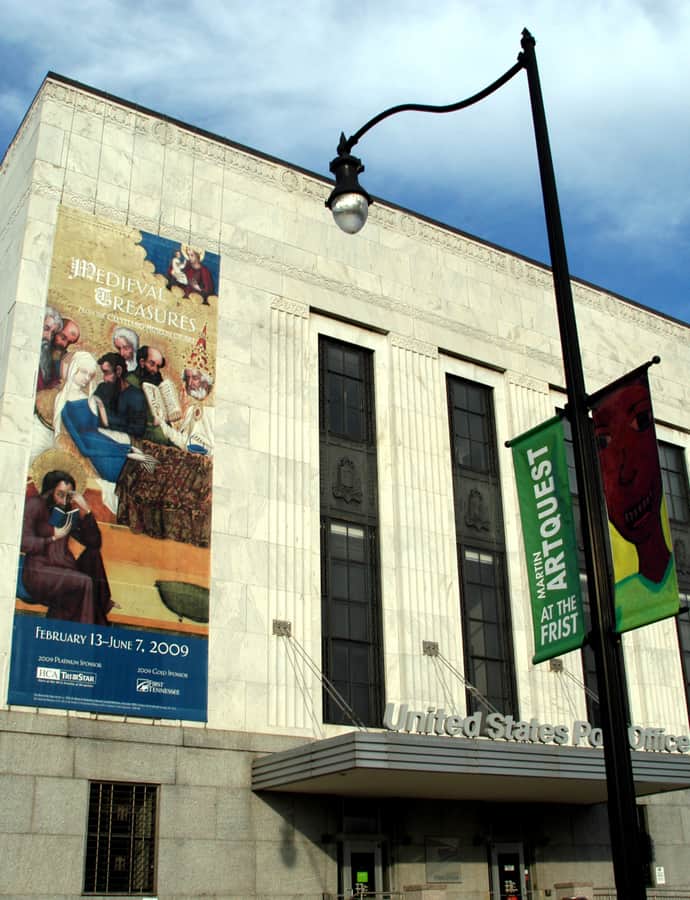

The Frist Art Museum occupies Nashville's former main post office, a white marble Art Deco building designed by Marr & Holman and built in 1933-34 for $1.5 million, its site chosen for proximity to Union Station when most mail moved by train. By the 1980s downtown no longer suited postal distribution, and after a new main post office opened near the airport in 1986, the building was reduced to a small downtown branch. In the early 1990s Thomas F. Frist Jr. and his family, through the charitable Frist Foundation, identified the vacant post office as the site for a new art museum, brokering a public-private venture with the U.S. Postal Service and the city of Nashville that opened the museum in 2001. The building is listed on the National Register of Historic Places.
the building
Built to move mail by rail. Marr & Holman designed the post office in 1933-34 specifically for its location near Union Station, when most mail moved through the city by train.
A public-private rescue. As the postal service abandoned the building for a newer facility near the airport in 1986, the Frist Foundation partnered with the USPS and the city of Nashville to convert the vacant post office into a museum.
the style
Facts and the extract describe the building as Art Deco and Stripped Classicism (Moderne), a restrained federal style of the 1930s that gave the former post office its clean marble facade and geometric ornament.
More on Art Decothe architect
Marr & Holman designed the building as Nashville's main post office in 1933-34; no further biographical detail is documented here beyond this commission.
significance
The building is listed on the National Register of Historic Places. Its conversion from a working post office into the Frist Art Museum, completed through a public-private venture led by the Frist Foundation, is documented as a defining chapter of its history.
nearby
- Nashville Union Station
- Christ Church Cathedral
- Customs House
- Castner-Knott Building
- Rich-Schwartz Building
- Ryman Auditorium