
Nashville Union Station
- Style
- Richardsonian Romanesque
- City
- Nashville, TN
- Collection
- victorian nashville
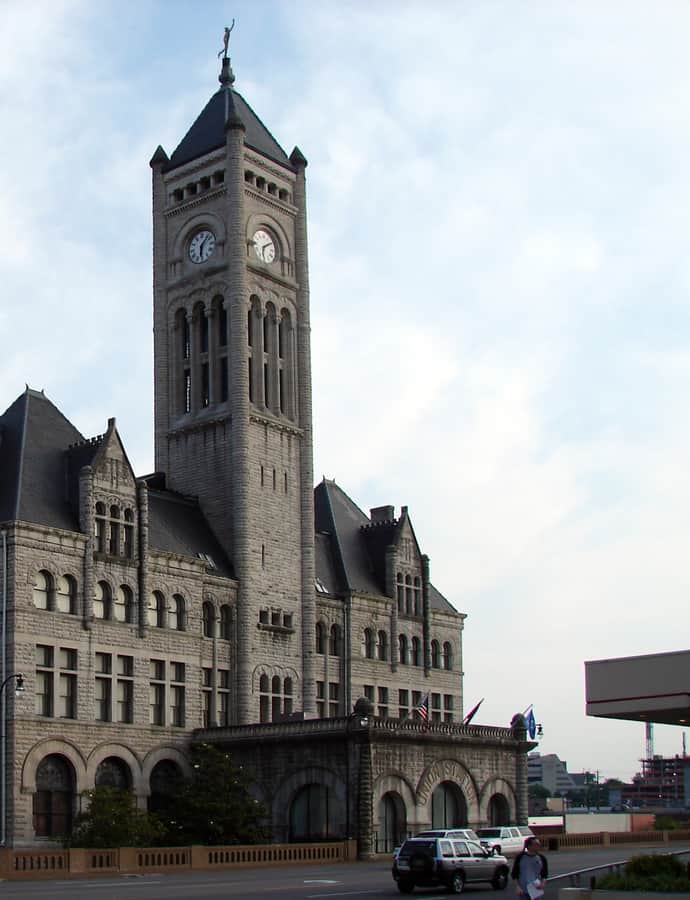

Nashville's Union Station was built beginning in 1898 and opened in 1900 as a railroad terminal serving the Louisville & Nashville Railroad and the Nashville, Chattanooga & St. Louis Line, at a moment when Nashville was growing into a modern Southern metropolis dependent on rail travel. Designed by Henry Hobson Richardson together with L&N engineer Richard Montfort, its Romanesque Revival stonework and clock tower stood apart from other train stations of the era. The last passenger train left in 1978; the building has since been reborn as a hotel with its barrel-vaulted hall intact.
the building
Clock tower. A stone clock tower anchors the terminal's silhouette, one of the identifying elements of its Romanesque Revival design and still a fixture of the downtown skyline.
Barrel-vaulted hall. The station's grand hall keeps its barrel-vaulted ceiling intact from its railroad days, now serving as the centerpiece of the hotel that occupies the building.
Viaduct and rail cut. The station was spanned by an adjacent viaduct and positioned above a natural railroad cut through which most area tracks were routed; it also served Nashville's streetcars until their discontinuation in 1941.
the style
Union Station is built in the Richardsonian Romanesque style, named for its architect, and its heavy stonework and round-arched forms made it stand out from typical train stations of the period -- a monumental civic face for a railroad terminal rather than a purely utilitarian shed.
More on Richardsonian Romanesquethe architect
Henry Hobson Richardson lent his name and Romanesque Revival vocabulary to the design, while Richard Montfort, an engineer for the Louisville & Nashville Railroad, spent years planning the building's actual construction.
significance
Nashville Union Station was designated to the National Register of Historic Places in 1975, not long before its last passenger train departed in 1978. It has since been converted from a working terminal into a hotel that preserves the original barrel-vaulted hall.
nearby
- Frist Art Museum
- Christ Church Cathedral
- Customs House
- Castner-Knott Building
- Rich-Schwartz Building
- Ryman Auditorium