
Grace Church
- Architect
- Richard Upjohn
- Style
- Gothic Revival
- City
- Newark, NJ
- Collection
- gothic revival
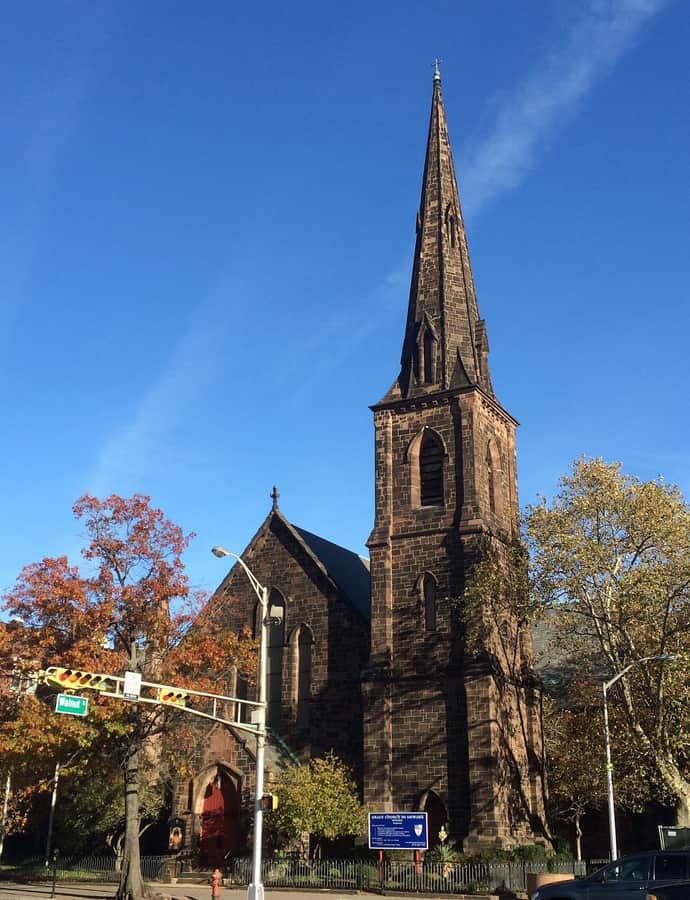

Grace Church was founded on Ascension Day in 1837 at the behest of Bishop George Washington Doane, a daughter parish of Trinity Church established to be the standard-bearer for Anglo-Catholicism in the growing city. The Gothic Revival building on Broad Street, designed by Richard Upjohn, was consecrated on October 5, 1848, and the congregation has worshipped there ever since. It is now a National Historic Landmark and remains an active Episcopal parish in the Anglo-Catholic tradition.
the building
An Oxford Movement parish. Grace was founded as part of the Oxford Movement, with its founders emphasizing sacramental worship and the succession of bishops as a direct link to Christ and the Apostolic community — a deliberate echo of Roman Catholic practice within the Episcopal Church. Bishop Doane explicitly wanted a standard-bearer for Anglo-Catholicism in Newark, and that mission still shapes worship here today.
Upjohn's Broad Street church. Richard Upjohn, the architect who also designed Trinity Church in New York, gave Grace its Gothic Revival building on Broad Street. Consecrated October 5, 1848, it has housed the congregation continuously since — eleven years after the parish itself was founded on Ascension Day in 1837.
the style
Grace Church is a Gothic Revival design by Richard Upjohn, the architect behind Trinity Church in New York. The style suited a parish founded to carry the Oxford Movement's sacramental, high-church emphasis into Newark — Gothic forms lending the young Episcopal congregation the visual authority of an older, apostolic church tradition.
More on Gothic Revivalthe architect
Richard Upjohn also designed Trinity Church in New York, one of the era's most prominent Gothic Revival churches; Grace Church in Newark shares that pedigree.
significance
Grace Church is a National Historic Landmark and is listed on the National Register of Historic Places, recognition of both its Gothic Revival architecture and its role since 1837 as a founding center of Anglo-Catholic worship in the Diocese of Newark.
nearby
- Newark City Hall
- Newark Symphony Hall
- Prudential Headquarters
- First National State Bank Building
- South Park Calvary United Presbyterian Church
- Catedral Evangelica Reformada