
Newark Symphony Hall
- Architect
- Grad Associates
- Year
- 1925
- Style
- Neoclassical
- City
- Newark, NJ
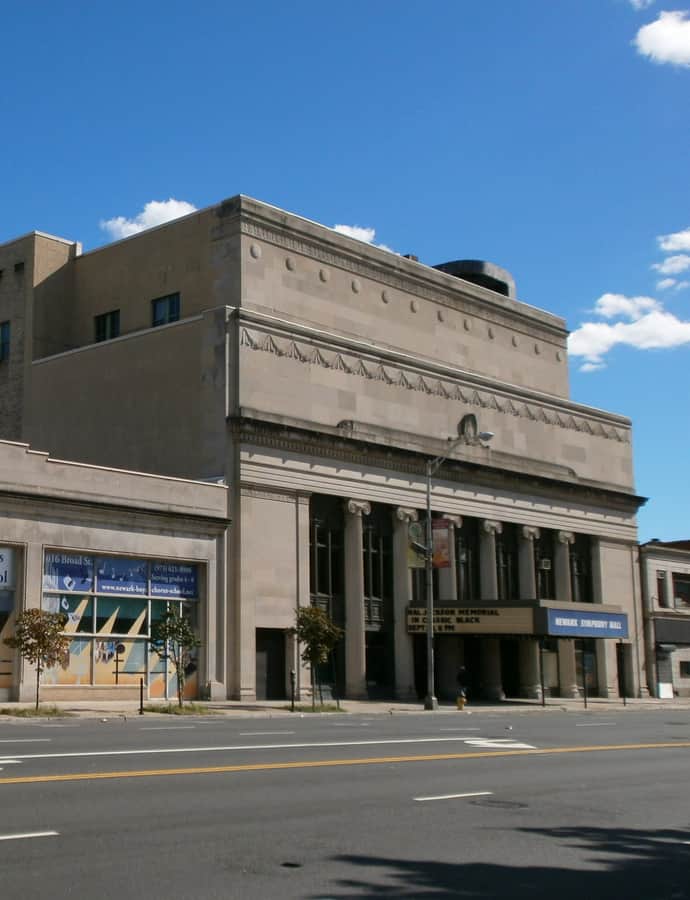

Newark Symphony Hall at 1020 Broad Street was built in 1925 by the Shriners at a cost of more than $2 million as the Salaam Temple, popularly known as The Mosque, and designed by prominent Newark architect Frank Grad in Neoclassical style. It has been Newark Symphony Hall since 1964 and was listed on the National Register of Historic Places in 1977, formerly serving as home to the New Jersey Symphony Orchestra, New Jersey State Opera, and New Jersey Ballet Company.
the building
Greek and Egyptian interior. The four-story interior mixes Greek and Egyptian motifs with marble columns, a crystal chandelier, gold-leaf fretwork, and two-columned side promenades — ornamental range built for a fraternal order's temple rather than a concert hall.
The Sarah Vaughan hall. The 3,500-seat main concert hall is named for Sarah Vaughan, a native Newarker, and is renowned for its acoustics.
the style
Frank Grad designed the building in a neo-classical style for the Shriners, whose Salaam Temple gave the building its long-used nickname, The Mosque.
More on Neoclassicalthe architect
Frank Grad was a prominent Newark architect whose other work includes the Lefcourt Newark Building and many other buildings downtown.
significance
Newark Symphony Hall was added to the National Register of Historic Places in 1977 and is owned by the Essex County Improvement Authority, operated today by the non-profit Newark Performing Arts Corporation.
nearby
- South Park Calvary United Presbyterian Church
- Catedral Evangelica Reformada
- Grace Church
- Newark City Hall
- St. James' A. M. E. Church
- Prudential Headquarters