
Church of The Epiphany
- Architect
- Thomas Ustick Walter
- Year
- 1834
- Style
- Greek Revival
- City
- Philadelphia, PA
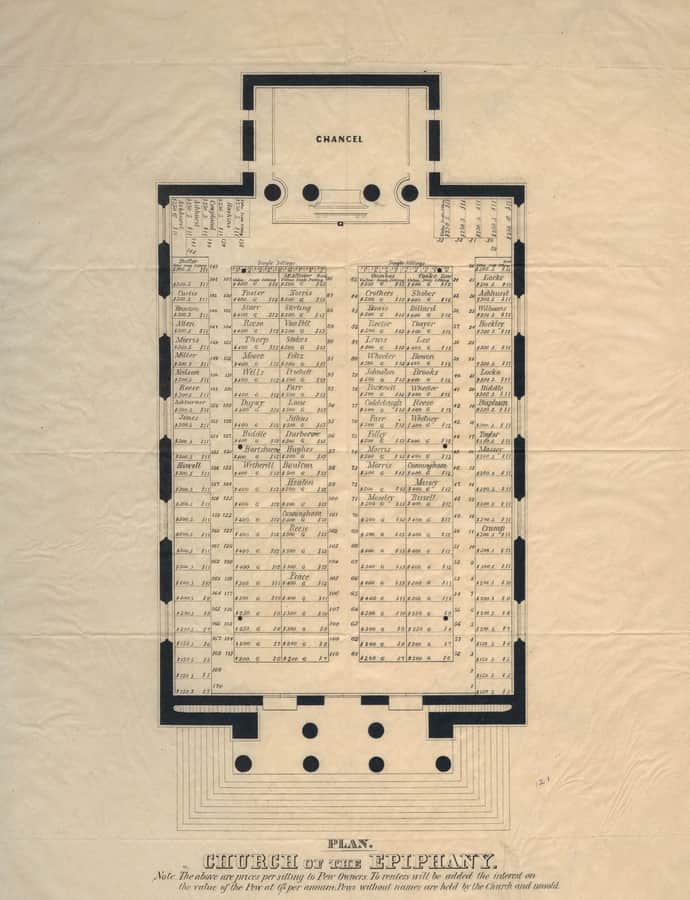

The Church of the Epiphany was an Episcopal congregation organized in 1834 for Philadelphia's growing neighborhood around Broad and Chestnut Streets, its Greek Revival building at 1501-15 Chestnut Street designed by a young Thomas Ustick Walter, decades before he became architect of the US Capitol dome. Bishop William White laid the cornerstone on March 24, 1834, and consecrated the finished church that October 12th, installing Stephen H. Tyng, a leading evangelical preacher, as first rector. The congregation outlasted its building, merging with St. Luke's Church in 1898 to form the Church of St. Luke and the Epiphany after the original Chestnut Street church was demolished in 1902.
the building
Rev. Stephen Tyng. The church's first rector, Stephen H. Tyng, was a national leader of the evangelical movement, and under him the congregation became a meeting place for evangelicals across denominations. He was an outspoken critic of the Roman Catholic Church, yet just as fiercely opposed the anti-Catholic Philadelphia Nativist Riots of 1844 - a contradiction that marked his tenure as much as his oratory did.
A vanished building. Walter's 1834 Greek Revival church at 1501-15 Chestnut Street didn't survive the century: the congregation merged with St. Luke's in 1898, and the building itself was demolished in 1902, leaving the design known today mainly through the record of Walter's early career, before he went on to design the dome of the US Capitol.
the style
The Church of the Epiphany was built in the Greek Revival style, the classical idiom Thomas Ustick Walter was working in early in his career - well before the very different, dome-topped vocabulary he'd later bring to the US Capitol in Washington.
More on Greek Revivalthe architect
Thomas Ustick Walter designed the Church of the Epiphany in 1834 as one of his notable early commissions, years before he became one of the most consequential architects in American history: the designer of the dome of the US Capitol.
significance
The congregation merged with St. Luke's Church in 1898 to become the Church of St. Luke and the Epiphany, and the original 1834 Chestnut Street building was demolished in 1902 - the site's Greek Revival presence surviving now only in the record of a major American architect's early career.
nearby
- Land Title Building
- Ritz-Carlton Philadelphia
- Liberty Place
- BNY Mellon Center
- One South Broad
- North American Building