
Victoria Mansion
- Architect
- Henry Austin
- Style
- Italianate
- City
- Portland, ME
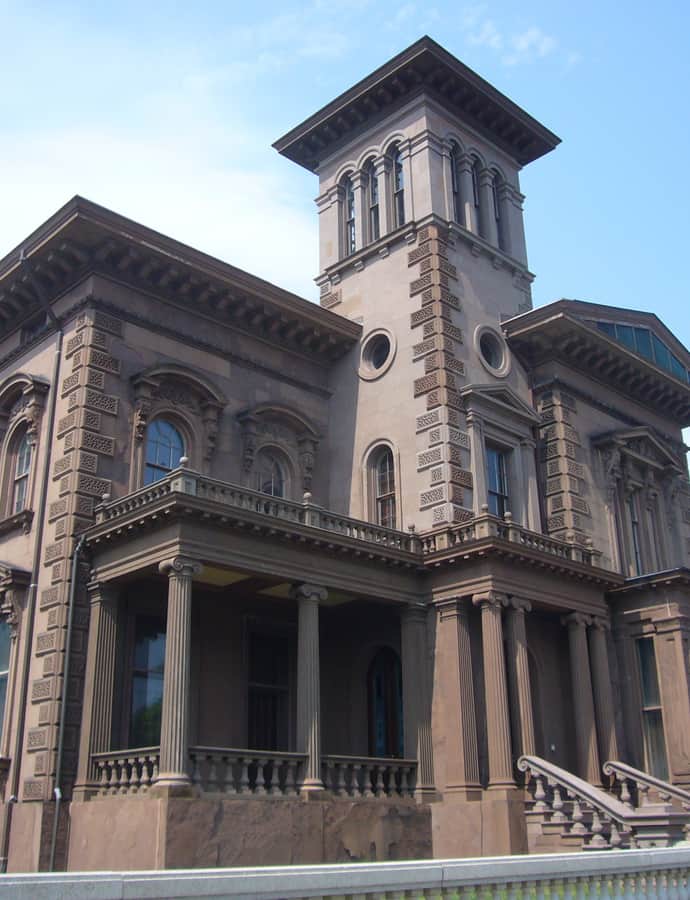

Victoria Mansion, also known as the Morse-Libby House, was completed in 1860 as a summer home for hotelier Ruggles Sylvester Morse, who made his fortune running hotels in New York, Boston, and New Orleans before bringing that money back to his home state. Designed by New Haven architect Henry Austin, the brownstone Italianate villa is considered one of the finest and least-altered examples of its kind in the United States. It was declared a National Historic Landmark in 1971 for its architectural significance.
the building
Asymmetric form. The house departs from strict symmetry with a four-story tower, overhanging eaves, verandas, and ornate windows, giving the massing a picturesque, villa-like silhouette typical of the Italianate mode Austin was working in.
Painted interiors. The frescoes and trompe-l'œil wall decorations inside were created by the artist and decorator Giuseppe Guidicini, contributing to an interior described as a detailed portrait of lavish nineteenth-century living.
Herter's earliest interiors. Gustave Herter created the interiors in a range of styles; this house holds his earliest known interior work, making it a starting point for a career that would define American Gilded Age decoration.
the style
Austin worked in the Italianate mode, favored for its asymmetry and its ability to suggest the villas of the Italian countryside. Here that meant a brownstone exterior, a tall tower, and eaves deep enough to cast heavy shadow lines across the facade -- details that read from the street as unmistakably different from the plainer Federal and Greek Revival houses common in Portland at the time.
More on Italianatethe architect
Henry Austin practiced out of New Haven, Connecticut. Victoria Mansion stands as one of his most complete and best-preserved surviving works, executed for a client with the means to fund an unusually elaborate commission.
significance
Declared a National Historic Landmark in 1971 and listed on the National Register of Historic Places, recognized as one of the finest and least-altered large Italianate brick and brownstone homes surviving in the United States.
nearby
- Wadsworth-Longfellow House
- Neal S. Dow House
- Portland City Hall
- United States Customhouse
- Cathedral of the Immaculate Conception
- John Calvin Stevens House