
North Carolina State Capitol
- Architect
- Alexander Jackson Davis
- Year
- 1833
- Style
- Neoclassical
- City
- Raleigh, NC
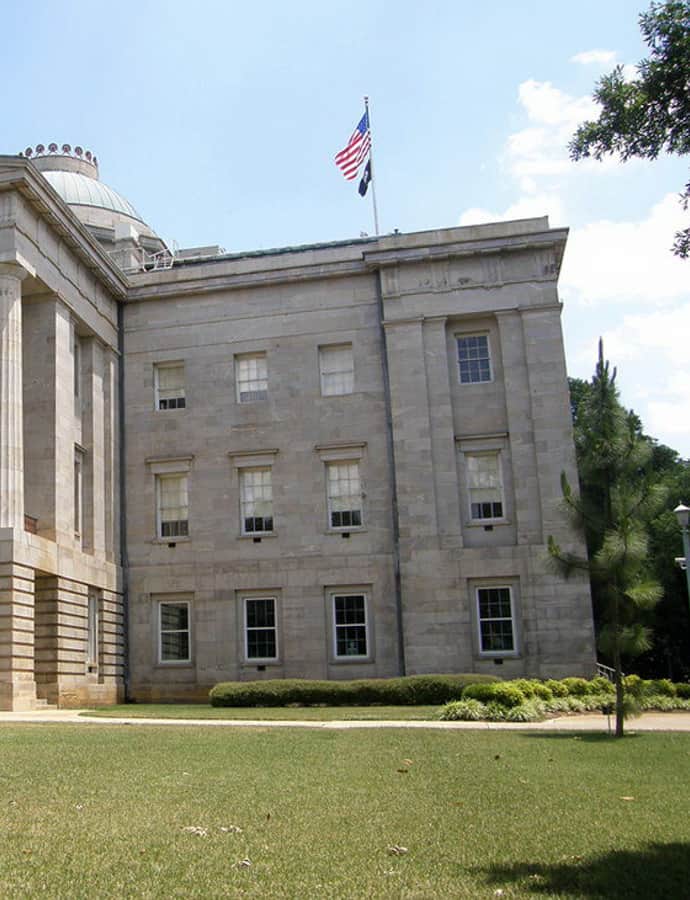

The North Carolina State Capitol was built after fire destroyed the original State House in 1831, with its cornerstone laid on Union Square on July 4, 1833, and construction finished in 1840. Design passed through a sequence of hands — William Nichols Sr. and Jr., then the firm of Ithiel Town and Alexander Jackson Davis, then David Paton — but it is Davis's Greek Revival vision that defines the building most. It housed the entire state government until the Supreme Court and State Library moved out in 1888 and the General Assembly left for the State Legislative Building in 1963; today the governor's offices remain on the first floor.
the building
A building by committee. The design most associated with Alexander Jackson Davis was actually assembled by a chain of architects: William Nichols Sr. and his son William Nichols Jr. began the work, the firm of Ithiel Town and Davis carried it forward, and David Paton finished it. Few surviving state capitols show this kind of layered authorship so plainly.
Laid with Masonic honors. The cornerstone was set on July 4, 1833, by Simmons Jones Baker, Grand Master of North Carolina Masons — a ceremonial start that tied the new statehouse to civic ritual from its first day.
A shrinking government building. The Capitol once held the entire state government. The Supreme Court and State Library were the first to leave, moving to their own building in 1888, and the General Assembly followed in 1963 into the State Legislative Building, leaving only the governor's first-floor offices behind.
the style
Built in the Greek Revival idiom favored for American statehouses of the era, the Capitol replaced an earlier State House lost to fire in 1831 — a rebuilding that gave North Carolina reason to invest in a monumental civic temple on Union Square.
More on Neoclassicalthe architect
Alexander Jackson Davis worked with his partner Ithiel Town on the Capitol's design, one stage in a design history that also included William Nichols Sr. and Jr. before them and David Paton after. Davis and Town's firm was among the most prominent American architectural practices of the period.
significance
The North Carolina State Capitol is a National Historic Landmark and is listed on the National Register of Historic Places.
nearby
- Agriculture Building
- First Baptist Church
- Christ Episcopal Church
- Odd Fellows Building
- North Carolina State Legislative Building
- State Bank of North Carolina