
Samuel Hyde House
- Style
- Neoclassical
- City
- Seattle, WA
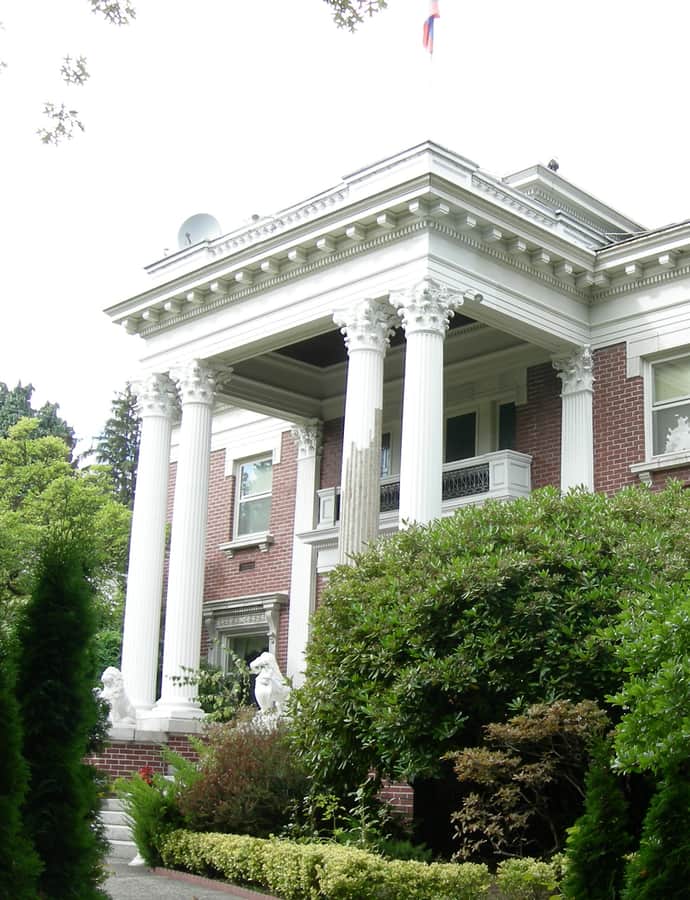

The Samuel Hyde House was built in 1909-1910 at 3726 East Madison Street for liquor magnate Samuel Hyde, designed by the firm Bebb & Mendel with grounds laid out by John Charles Olmsted, whose firm also shaped Seattle's park and boulevard system and landscaped the 1909 Alaska-Yukon-Pacific Exposition at the University of Washington. Hyde sold the house just six years after it was finished to focus on his coal industry investments, and after passing through numerous owners, it was purchased by the US government in 1994 for $1.1 million to house Russia's Seattle consul general.
the building
Corinthian portico. The two-story brick house presents a portico with Corinthian columns at its front, with a brick carriage house standing behind it, a formal, classically detailed entrance built for a coal and liquor fortune.
Olmsted-designed grounds. The property's grounds were laid out by John Charles Olmsted, whose firm designed Seattle's system of parks and boulevards and landscaped the grounds of the 1909 Alaska-Yukon-Pacific Exposition on the University of Washington campus.
the style
The Samuel Hyde House is a Neoclassical building, its Corinthian-columned portico giving Hyde's 1910 residence the formal classical vocabulary favored by wealthy industrialists of the period.
More on Neoclassicalthe architect
The house was designed by the Seattle firm Bebb & Mendel, with landscape design by John Charles Olmsted, part of the Olmsted Brothers firm responsible for Seattle's park and boulevard system.
significance
The Samuel Hyde House was designated a Seattle landmark on December 28, 1981, and listed on the National Register of Historic Places on April 12, 1982. In 1994, the US government purchased the house for $1.1 million through the Office of Foreign Missions, and it has since served as a residence for Russia's Seattle consul general.
nearby
- Ellsworth Storey House
- UW Canoe House/ASUW Shell House/US Naval Training Hangar
- Seattle Asian Art Museum at Volunteer Park
- 1600 East John Street Apartments
- Husky Stadium
- More Hall Annex