
The Capitol
- Architects
- William Thornton Thomas Ustick Walter George M. White Montgomery C. Meigs George Hadfield Alan Hantman David Lynn Stephen T. Ayers Étienne Sulpice Hallet Brett Blanton August Schoenborn Elliott Woods J. George Stewart James Hoban Benjamin Henry Latrobe Robert Mills Charles Bulfinch Edward Clark
- Year
- 1793
- Style
- Neoclassical
- City
- Washington, DC
- Collection
- the city beautiful
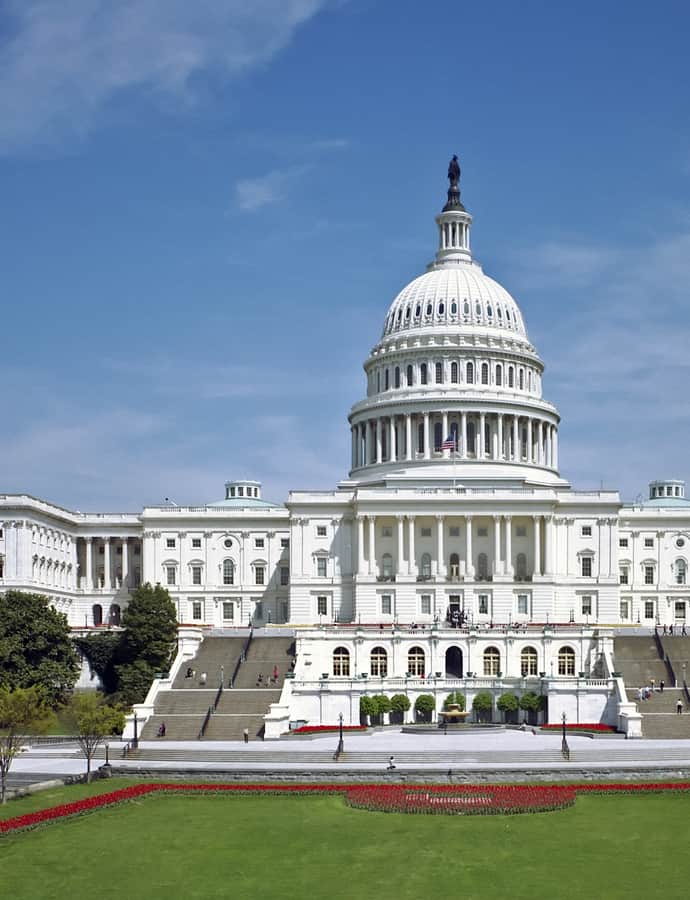

The United States Capitol is the seat of Congress, sited on Capitol Hill at the eastern end of the National Mall, and it serves as the origin point for Washington's street-numbering system and its four quadrants. Central sections were completed in 1800, just in time for the 6th Congress to convene there as the capital moved from Philadelphia, but British forces partly destroyed the building in the 1814 Burning of Washington, and it took five years to fully restore. Through the 19th century the House and Senate wings were extended as new states joined the union — the House in the south wing, the Senate in the north — and the Capitol's massive dome was added to crown the enlarged building.
the building
A long list of architects. The Capitol passed through the hands of numerous architects over its history, including William Thornton, Benjamin Henry Latrobe, Charles Bulfinch, Thomas Ustick Walter, and Robert Mills, reflecting a building that was added onto continuously as Congress itself grew.
Rebuilt after the fire. British troops set fire to the Capitol during the 1814 Burning of Washington in the War of 1812, partially destroying the building; it was fully restored within five years.
the style
The Capitol is built in the Neoclassical style with a white exterior, the same architectural language used for the principal buildings of the executive and judicial branches in Washington.
More on Neoclassicalsignificance
The Capitol is a National Historic Landmark, a Historic Civil Engineering Landmark, and listed in the District of Columbia Inventory of Historic Sites. It also serves as the origin point for Washington's street-numbering system and its four quadrants.
nearby
- Thomas Jefferson Building
- Hiram W. Johnson House
- Library of Congress
- House Office Building (Cannon House Office Building)
- Senate Office Building (Russell Senate Office Building)
- Supreme Court